




Website losing trust is a harder problem to spot than losing traffic. Traffic shows up in a dashboard as a falling line. Trust disappears silently, in the two seconds before someone closes the tab and calls a competitor instead.
Most businesses chase the visible metric. They pour money into ads and SEO to fill the top of the funnel, then wonder why enquiries don’t follow. Often the traffic is healthy. What’s leaking is belief: whether the visitor believes this business is real, current and safe to hand their details to.
This guide covers what a website losing trust actually looks like, the research behind why it happens in seconds, and the fixes that put trust back before a redesign is even on the table. Along the way we’ll look at a real-world example of two nearly identical sites with very different results. It’s written for Australian business owners and marketers in Sydney, Melbourne, Brisbane, Perth, Adelaide and Canberra.
The Short Answer
A website losing trust usually isn’t a traffic problem. Visitors judge credibility within milliseconds, mostly from visual design, and then confirm or reject that first impression using signals like security cues, real contact details, social proof and up-to-date content. Fix those signals and the same traffic converts into more enquiries, without spending another dollar on ads.
The Research Behind First-Impression Trust
This isn’t a guess. The Stanford Web Credibility Research studied how more than 4,500 people judged real websites and found that people rely heavily on surface-level cues such as layout, typography and colour to decide whether a site is credible, often before reading a word of content. Design carries more weight in that first judgement than the copy a business spent weeks writing.
That first impression sticks. Once someone has mentally filed a site as “looks a bit off”, every following signal gets read through that lens: a broken form feels careless rather than accidental, a stock photo feels generic rather than professional, a missing address feels evasive rather than an oversight.
Why Losing Trust Costs More Than Losing Traffic
A website losing trust is also harder to justify fixing internally, because there’s no red number on a dashboard forcing the conversation. That’s exactly why it persists longer than a traffic problem would.
Traffic decline is visible and gets fixed. A website losing trust is quieter and more expensive, because the money spent to attract each visitor has already been spent by the time trust fails.
| Losing traffic | Losing trust | |
| How it shows up | A visible drop in analytics | Visitors arrive, then quietly leave |
| What it costs | The ad or SEO spend to attract that visitor | That spend, plus the customer they became for a competitor |
| How it’s noticed | A dashboard alert | Rarely noticed without checking session recordings or asking customers directly |
| How it’s fixed | More campaigns, more content | Design, copy and credibility signals, often without new spend |
A site can rank well, get clicks, and still convert poorly, because ranking measures relevance to a search query. It says nothing about whether the page itself earns belief once someone lands on it.
5 Signals of a Website Losing Trust
These are the five signals that show up again and again when a website is losing trust, roughly in the order visitors notice them.
1. Security signals that don’t reassure
No padlock, an expired certificate warning, or a checkout that looks patched together tells a visitor their card details aren’t safe here, even if the backend is perfectly secure. The visual cue matters as much as the actual protection.
2. Weak or missing social proof
A handful of generic five-star quotes with no names, no photos and no specifics reads as filler. Real reviews, case studies with numbers, and recognisable client logos do the opposite: they let a stranger borrow someone else’s confidence.
3. Design that looks unfinished or dated
Inconsistent fonts, stretched images, or a layout that clearly hasn’t been touched since 2016 all read as “we don’t maintain this”, which visitors extend to “we probably don’t maintain our service either”.
4. Vague or evasive information
No physical address, no real phone number, an About page with no names or photos. None of these are illegal. All of them raise the same unspoken question: who exactly am I dealing with?
5. Inconsistency between what’s promised and what’s shown
An ad promises “same-day service” and the website never mentions it again. Pricing on the homepage doesn’t match the quote page. Small mismatches like these read as carelessness at best, and dishonesty at worst.
Trust Signal Checklist: What to Fix and Where
Use this as a working checklist rather than a one-off audit. A website losing trust rarely fails on one signal; it’s usually two or three compounding at once.
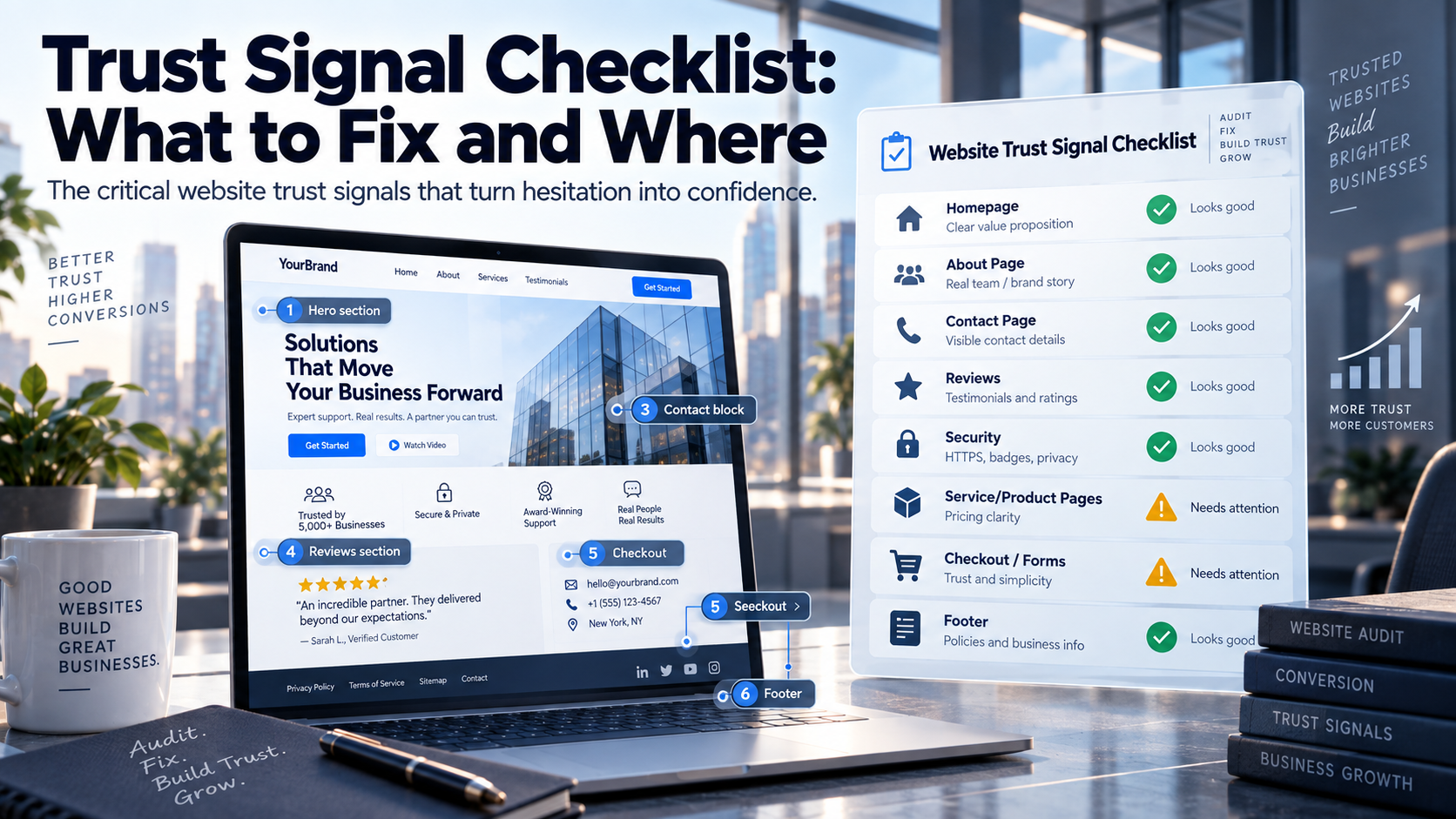
| Trust signal | What builds it | Where it belongs |
| Security | Valid SSL, visible security badges, a professional checkout | Every page, especially forms and checkout |
| Social proof | Named reviews, case studies with results, recognisable logos | Homepage and service pages |
| Professionalism | Consistent branding, current design, real photography | Site-wide |
| Transparency | Real address, phone number, named team, clear policies | Contact and About pages |
| Consistency | Matching promises across ads, homepage and service pages | Wherever a claim is made |
| Freshness | Recently updated content, current copyright year, active blog | Homepage, footer, blog |
| Ease of use | Working forms, fast load times, a website that behaves as expected | Site-wide |
A Real Example: Same Traffic, Different Outcome
Picture two tradie websites running the same Google Ads campaign, spending the same budget, getting the same click volume. Site A has a stock photo hero image, a contact form with no confirmation message, and reviews that just say “Great service! 5 stars” with no names. Site B has real job photos, a form that confirms submission and tells you when to expect a call, and five reviews with first names, suburbs and a specific detail about the job.
Both sites get the same visitors. Site A is a website losing trust in real time, and its enquiry rate reflects it. Site B converts noticeably better, not because it ranks higher or costs more to run, but because every element on the page answered an unspoken question before the visitor had to ask it.
A Quick Way to See It Yourself
Open the homepage on your phone, on 4G rather than office Wi-Fi, and give yourself five seconds. Would you trust this business with your card details or your phone number? If the honest answer is “I’d want to check a bit more first”, that hesitation is exactly what’s happening to real visitors, minus the time to explain why.
How This Plays Out by City
Trust expectations shift slightly by industry and location. This is a general pattern, not a rule, so weigh it against your own analytics.
| City | Where trust gaps show up most | What matters most locally |
| Sydney | Professional services and finance, where scrutiny is high | Security cues and credentials, not just design polish |
| Melbourne | Retail and hospitality, where competition is visual | Design quality and brand consistency |
| Brisbane | Trades and local services | A real address, phone number and genuine local reviews |
| Perth | Resources-adjacent and B2B services | Case studies and evidence of real project experience |
| Adelaide | Small and family-run businesses | Personal touches, named staff and local social proof |
| Canberra | Government-adjacent and compliance-conscious sectors | Transparency, clear policies and up-to-date content |
Fixing a Website Losing Trust: Where to Start
- Audit first. Walk through the checklist above as a stranger would, not as the business owner who knows the context.
- Fix the fast wins. Security badges, a real address, named testimonials and a current copyright year can be fixed in a week.
- Then fix the design. If the layout itself looks dated, that’s the deeper fix, since it colours every other signal on the page.
- Keep it consistent. Whatever you promise in an ad or on social media, make sure the website says the same thing.
If your problem is more about traffic converting into enquiries than trust itself, our posts on why your website gets traffic but no leads and the 7 conversion killers hidden on most business websites cover that ground in detail. If you want to put a number on what it’s costing you, see our Website ROI Audit framework.
Trust vs Conversion: Two Different Problems
It’s worth separating a website losing trust from a website that simply has weak calls to action or a clunky checkout. Trust problems stop a visitor before they even consider acting. Conversion problems get in the way after someone has already decided to act. Both cost enquiries, but they need different fixes, and a website losing trust usually needs the first one solved before the second one matters.
Where a Web Developer Fits In
A trust audit tells you what’s wrong. Fixing it usually means updating the design, tightening the copy, and making sure the technical basics behind the scenes, like a valid certificate and a working contact form, are actually solid. Website Development Company works across website design and development, ecommerce development and custom web applications for Australian businesses that want their site to earn trust as well as traffic.
Website Losing Trust: Frequently Asked Questions
How do I know if my website is losing trust rather than just traffic?
Check whether traffic and time-on-site are healthy but enquiries are low. If people are arriving and leaving quickly without acting, that’s a trust and conversion issue, not a traffic issue. Session recordings and a five-second stranger test are the fastest way to confirm it.
What are the biggest trust killers on a small business website?
Missing contact details, generic or fake-looking reviews, outdated design, and inconsistent information between ads and the website are the most common. Security issues, like an invalid SSL certificate, are the most damaging because they’re immediately visible.
Does website design really matter more than content for trust?
For the first impression, yes. Research on how people evaluate real websites found visual design carries more weight than content in that first judgement. Content still matters once someone decides to stay and read, but design decides whether they stay at all.
Can I fix a website losing trust without a full redesign?
Often, yes. Security badges, real contact details, named testimonials and consistent messaging can be fixed quickly. If the underlying design itself looks dated, those fixes will help, but a redesign will do more.
How quickly do visitors decide whether to trust a website?
Very quickly. First impressions form in a matter of seconds, largely from visual design, well before someone has read enough copy to judge the business on its merits.
Your Next Step
A website losing trust rarely needs more traffic to fix it. It needs a stranger’s honest five seconds and a short list of fixes. Run the checklist above this week, fix what you can yourself, and get a second opinion on the rest.
Want a proper look at where your site is losing belief, not just visitors? Get in touch with our team for a trust and conversion review, or explore website design and development built for Australian businesses.