


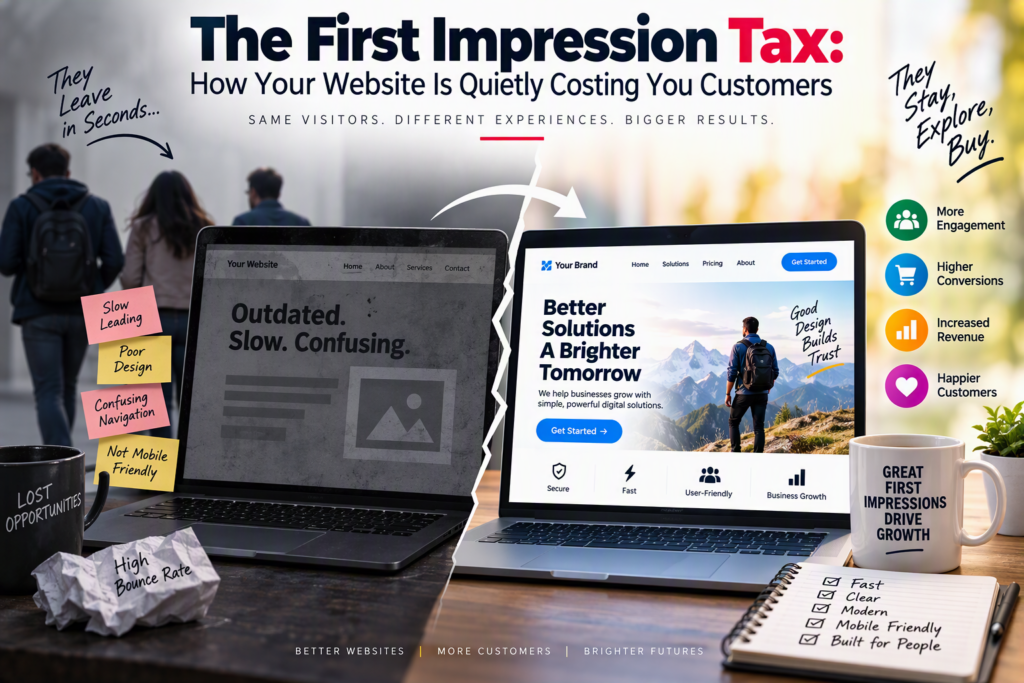
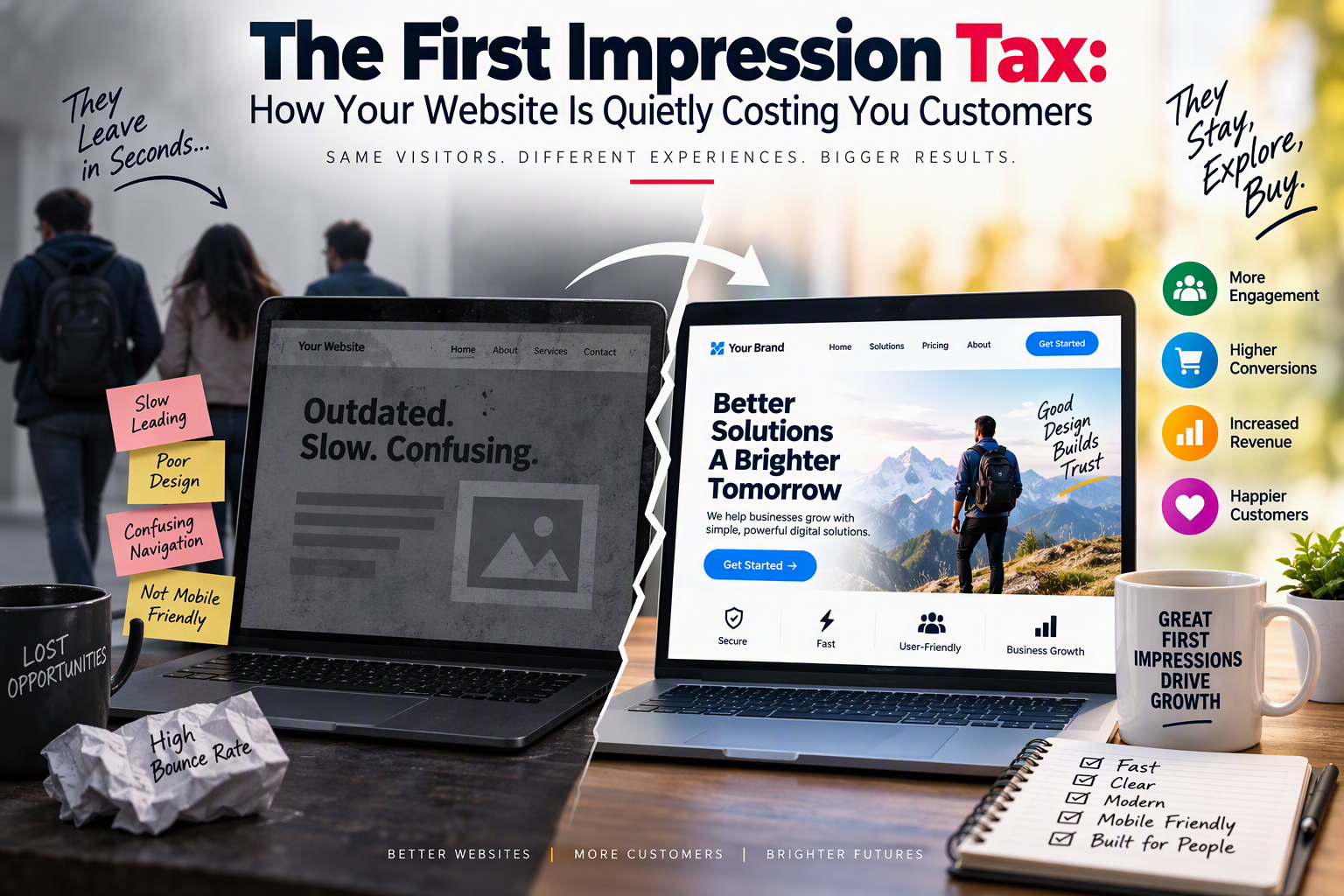
First impression tax is the cost every business pays, invisibly, on every single visitor who lands on their website. It isn’t a one-off design flaw it’s a recurring charge, deducted from your conversion rate every day, whether you notice it or not. Unlike a real tax, no one sends you a bill. It just shows up as a slightly lower enquiry rate, a slightly higher bounce rate, and a marketing budget that never quite performs the way the numbers say it should.
What Is the First Impression Tax?
Every visitor forms a judgement about your business within seconds of your website loading before reading a single word of copy. If that judgement is negative, they don’t complain, they don’t give feedback, they simply leave. That silent, invisible exit rate is the first impression tax: a percentage of every visitor your website quietly forfeits before your sales process even begins.
The first impression tax compounds because it applies to every visitor, from every channel, every day. A slow-loading, dated, or confusing website doesn’t just lose the occasional customer it taxes your entire marketing spend, including the Google Ads and SEO traffic you’ve already paid to attract.
Where the Tax Gets Charged: 6 Hidden Cost Points

1. Load Speed The Tax You Pay Before the Page Even Renders
Every additional second of load time increases abandonment before your message is even seen. Think with Google research found bounce probability rises sharply as mobile load time increases from one to five seconds a tax charged before your business has said a word.
2. Dated Design The Tax on Trust
A website that looks like it hasn’t been touched since 2018 signals a business that may not be actively operating, supported, or invested in regardless of how good the underlying product or service actually is.
- Unclear value proposition. If a visitor can’t tell what you do and why it matters within five seconds, they assume it’s not worth the effort to find out.
- Poor mobile rendering. With most traffic arriving on mobile, a desktop-first design taxes the majority of your visitors on their very first interaction.
- Missing trust signals. No reviews, credentials, or case studies visible above the fold means every visitor starts from zero trust instead of borrowed confidence.
- Buried or unclear calls to action. If the next step isn’t obvious, most visitors simply won’t look for it they’ll leave instead.
Calculating Your Own First Impression Tax
You can estimate the size of this hidden tax using your own traffic numbers. Here’s a sample calculation showing how it scales:
| Monthly Visitors | Estimated First-Impression Exit Rate | Visitors Lost Before Engaging | Enquiries Lost (at 3% baseline conversion) |
| 1,000 | 35–45% | 350–450 | 10–13 |
| 5,000 | 35–45% | 1,750–2,250 | 52–67 |
| 10,000 | 35–45% | 3,500–4,500 | 105–135 |
At even a modest average deal value, that’s a five- or six-figure annual cost hidden inside a metric most businesses never measure directly.
City-by-City: Where the First Impression Tax Hits Hardest
Local competition and mobile usage patterns shift how expensive this tax becomes across Australia:
| City | Local Pressure | What Reduces the Tax Locally |
| Sydney | High competitor density across most industries | Fast load speed and modern design as a baseline expectation |
| Melbourne | Design-literate audience, high visual standards | Polished, on-brand design with clear differentiation |
| Brisbane | Faster-growing small business market | Clear mobile-first value proposition |
| Perth | Strong mobile and regional traffic share | Reliable mobile rendering and fast load times |
| Adelaide | Smaller, closer-knit local markets | Visible trust signals and local credibility markers |
| Canberra | Government and professional-services heavy | Professional, compliance-appropriate design |
How to Stop Paying the First Impression Tax
Reducing this tax starts with the same technical foundations covered in our Core Web Vitals guide, paired with the visual first-impression research covered in our earlier post on why customers decide not to buy before they read your website. If trust not just speed or design is the bigger leak for your business, our post on why your website is losing trust breaks down the specific signals to fix first.
A properly built, fast, mobile-first website removes this tax at the source. Our Web Design and Development and Ecommerce Agency services are built around exactly this first impressions that convert instead of costing you customers. See our full range of services or get in touch for a free first-impression audit of your current site.
We work with businesses across Sydney, Melbourne, Brisbane, Perth, Adelaide and Canberra see our full locations page for details.
Frequently Asked Questions
What is the first impression tax on a website?
It’s the invisible percentage of visitors a website loses before they engage with any content, caused by slow load speed, dated design, unclear messaging or missing trust signals a hidden cost applied to every visitor, every day.
How do I know how much this is costing my business?
Estimate your monthly traffic, apply a 35–45% first-impression exit rate, and multiply the remaining lost visitors by your typical conversion rate and average deal value.
What’s the fastest way to reduce it?
Page speed improvements typically produce the fastest measurable reduction, followed by clarifying your above-the-fold value proposition and adding visible trust signals.
Is this the same as a low conversion rate?
It’s related but narrower the first impression tax specifically covers visitors lost in the first few seconds, before they’ve engaged enough to be counted as a genuine conversion opportunity at all.
Final Word
The first impression tax is one of the largest uncounted costs in Australian business marketing, because it happens silently, before any tracking tool logs an event. Fix load speed, design currency, mobile rendering and trust signals together, and you stop paying a tax most businesses don’t even know exists.