


Your website first impression is a handshake that happens before you say a single word. A stranger lands on your homepage, and inside a blink they have decided whether you look capable, careful and worth a phone call. Nobody announces the verdict. They simply stay, or they tap the back button and open a competitor.
That is the idea behind the digital handshake. A good one is firm, warm and over quickly. A bad one is limp, awkward or somehow sticky. Research published in the journal Behaviour & Information Technology found that people form a visual opinion of a web page in as little as 50 milliseconds, which is quicker than you can read this sentence. If your business depends on enquiries, bookings or online sales, that opening moment deserves more attention than almost any other part of your marketing.
In this guide we unpack what your site is telling people before you get the chance to, why it matters for Google rankings as well as customers, and how Australian businesses from Sydney to Perth can close the gaps. It draws on the kinds of problems we see when we audit sites at Web Development Company.
Why Your Website First Impression Decides the Sale
Think about walking into a shop. Before anyone greets you, you have noticed whether the lights are on, whether the shelves are tidy and whether the place feels like somebody cares. Your website works the same way. Layout, load speed, fonts, photos and wording all speak on your behalf, quietly and constantly.
Google’s own research, widely cited by performance teams, has reported that more than half of mobile visits are abandoned when a page takes longer than three seconds to load. You can read the current guidance in web.dev’s overview of Core Web Vitals. A slow page never gets the chance to show off great copy or lovely product photos. The handshake ended before it began.
A strong website first impression does three jobs at once. It tells visitors they are in the right place, it signals that you are legitimate, and it makes the next step obvious. When those three things line up, enquiries rise without any extra advertising spend.
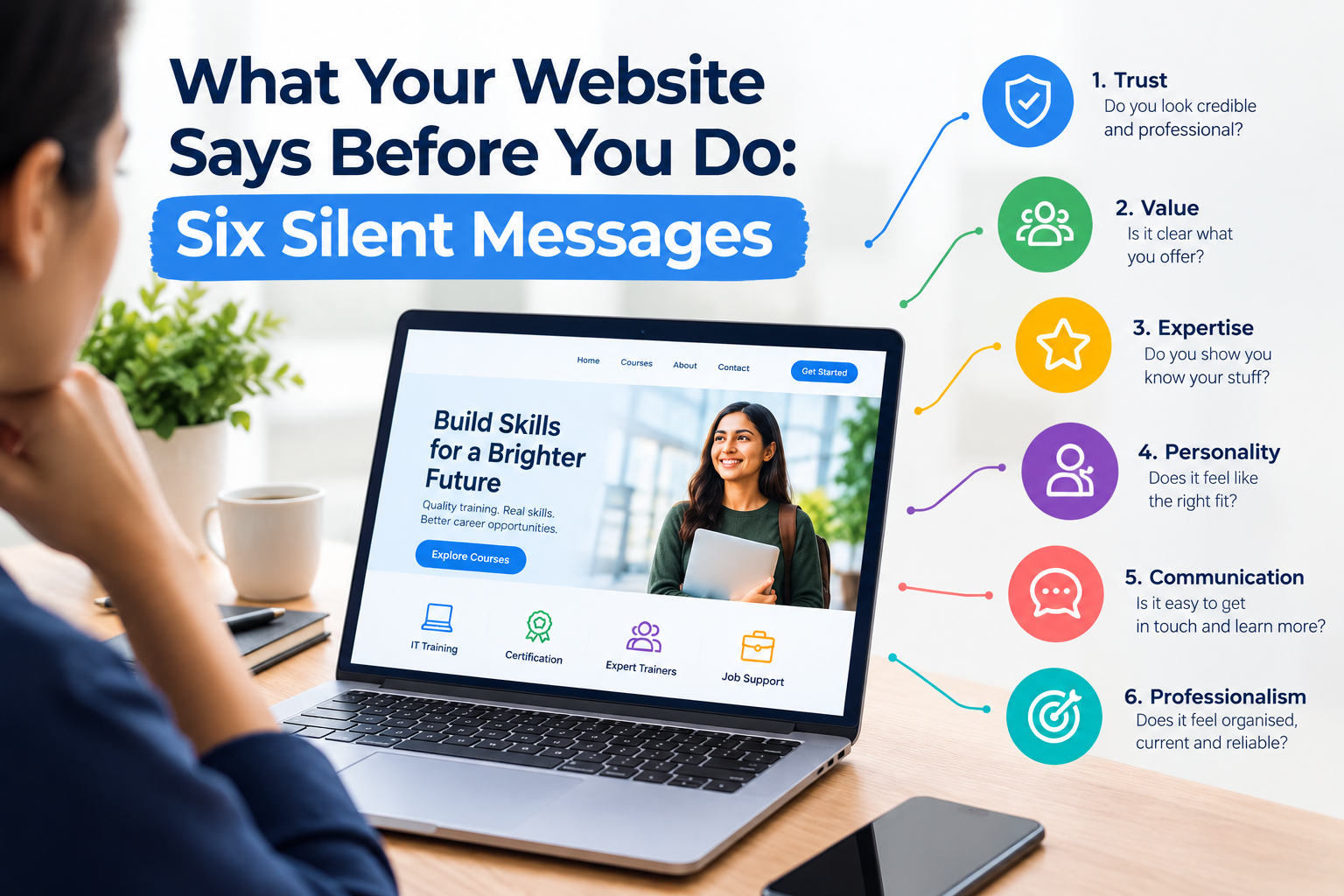
What Your Website Says Before You Do: Six Silent Messages
Visitors rarely list the reasons they trust or distrust a site. They feel it. Here are the six messages your pages send in the first few seconds.
1. Speed says “we respect your time”
A fast site feels confident. A slow one feels neglected. Slow load times usually come from oversized images, heavy plugins, cheap hosting or bloated code. Compress images, use modern formats such as WebP and trim the plugins you no longer need. If you run WordPress, our WordPress development services start every project with performance, because speed is the cheapest way to improve your website first impression.
2. Mobile design says “we live in the present”
A large share of Australians browse on their phones, often one-handed and often on a train or in a queue. If buttons are tiny, text needs pinching or menus overlap, the handshake feels clumsy. Mobile-first layouts put the phone number, the main call to action and the key offer within thumb reach. Our web design and development work treats the phone screen as the main stage, not an afterthought.
3. Trust signals say “we are real”
A padlock in the address bar, a real street address, an ABN, honest reviews and clear contact details all work like a firm grip and steady eye contact. Secure HTTPS is the baseline, and the Australian Cyber Security Centre publishes practical guidance for small businesses on protecting sites and customer data. Add genuine testimonials, recognisable payment logos and a visible privacy policy, and hesitant visitors relax.
4. Clear messaging says “we know what we do”
Within five seconds a visitor should be able to answer three questions: what do you offer, who is it for, and what should I do next? Vague slogans fail this test. “Innovative solutions for modern challenges” says nothing. “Custom Shopify stores for Australian fashion brands” says everything. Plain words beat clever ones every time.
5. Accessibility says “everyone is welcome”
Good contrast, readable font sizes, descriptive alt text and keyboard-friendly menus make your site usable for more people, including those with low vision or limited mobility. The W3C Web Content Accessibility Guidelines are the global reference. Accessible sites also tend to perform better in search, because the clean structure that helps screen readers helps Google understand your pages.
6. Fresh content says “we are still open”
An out-of-date copyright year, a blog last touched years ago or a team page showing staff who left long ago sends a worrying signal. Visitors wonder whether anyone is home. Regular updates, even small ones, keep the handshake warm. Our blog shows how steady publishing keeps a site feeling alive.
A Website First Impression Checklist for Australian Businesses
Run your homepage through this list to test your website first impression, preferably on your phone and preferably with a friend who has never seen your business.
- Does the page load in under three seconds on mobile data?
- Can a stranger explain what you do after five seconds of looking?
- Is there one clear call to action above the fold, such as Get a Free Quote?
- Is your phone number visible without scrolling and tappable on mobile?
- Does the site use HTTPS with no browser warnings?
- Are your images sharp, original and compressed?
- Do your menus, buttons and forms work on small screens?
- Do you show proof, such as reviews, case studies or client logos?
If you answered no to more than two of these, your website first impression is probably costing you enquiries. A free website audit is the quickest way to find out exactly where.
Website Design and Development Across Australian Cities
Local search intent is strong in Australia. People type phrases like “web developer Melbourne” or “website designer Brisbane” because they want someone nearby, or at least someone who understands the local market. Matching your pages to those searches is part of building a good website first impression for people and search engines alike.
- Web development Sydney: Sydney businesses, from Surry Hills start-ups to CBD professional firms, compete in a crowded market where polish and speed stand out.
- Web development Melbourne: our West Melbourne office supports ecommerce brands, creative studios and service firms that need sites with personality and performance.
- Web development Brisbane: Brisbane’s tourism, construction and health sectors need websites that turn enquiries into bookings.
- Web development Adelaide: Adelaide’s food, education and manufacturing businesses benefit from sites that tell a credible local story.
- Web development Canberra: consultancies and suppliers working with government need clear, accessible and secure websites.
- Web development Perth: resources, trades and services businesses often reach regional clients, so mobile speed on patchy connections counts.
Based in Hobart or elsewhere? We also support clients live online. Visit our locations page to see which team is closest to you.
Choosing a Platform That Supports a Strong Website First Impression
The platform behind your site shapes how fast it loads, how easy it is to update and how well it grows. There is no single best answer, only the best fit for your goals.
- Shopify development services: ideal for retailers who want a polished store, reliable hosting and a quick launch.
- WooCommerce development: flexible for stores that need custom features, ERP integrations or full control inside WordPress.
- WordPress development: a strong choice for content-heavy business sites, service firms and blogs.
- Webflow development: suits design-led brands that want a precise website first impression without heavy code.
- Magento development and B2B ecommerce website development: built for large catalogues and complex wholesale journeys.
Already stuck on an old platform? Website migration services and an ecommerce website redesign can refresh the handshake without losing the rankings you have already earned.
How Your Website First Impression Affects SEO and Google Rankings
People often treat design and SEO as separate projects. Google does not. Its Search Central guidance on helpful content makes clear that pages written for people, showing real experience and trustworthiness, are the ones it wants to reward. Signals such as Core Web Vitals, mobile usability and HTTPS also feed into page experience.
Behaviour matters too. If visitors bounce because the first screen feels confusing, you lose more than one visit. You also lose the chance to earn reviews, shares and links. These practical steps support your website first impression and your rankings together:
- Put your main keyword in the page title, the first paragraph, at least one subheading and the URL.
- Write a meta description that promises something specific and ends with a call to action.
- Add descriptive alt text to images, including your focus keyword where it fits naturally.
- Link related pages together so visitors and Google can follow your site structure.
- Claim and complete your Google Business Profile so your name, address and phone number match your website.
- Watch Google Search Console for mobile usability and speed issues, and fix them early.
Our ecommerce SEO services and small business website development packages build these habits in from day one, so your site is search-ready at launch rather than patched afterwards.
Common Mistakes That Ruin a Website First Impression
These habits quietly damage a website first impression, and most are cheap to fix.
- Autoplay video and pop-ups. Nobody likes a stranger shouting at the door.
- Generic stock photos. Real team and product photography builds trust faster.
- Too many choices. A menu with fifteen items is a maze. Group pages and spotlight the top three.
- Hidden pricing guidance. You do not need exact figures, but a clear starting point saves everyone time. See our guide to website design and SEO package pricing in Australia.
- Broken links and forms. One dead Contact button can cost more than a month of advertising.
- Walls of text. Short paragraphs, clear subheadings and white space help people scan.
Build Your Skills: Digital Marketing Course Resources
If you manage your own site, a little training goes a long way. A practical digital marketing course covers SEO, content, analytics and paid advertising, the skills that turn a good website first impression into steady leads. Pair that with the free documentation on Google Search Central and you will speak the same language as your developer.
Website First Impression FAQs
How quickly do people judge a website?
Studies suggest visual judgements form in a fraction of a second, and the decision to stay or leave happens within a few seconds. That is why the top of your homepage shapes your website first impression more than anything below it.
What matters most for a good website first impression?
Clarity. Visitors need to understand what you offer and what to do next. Speed, mobile design and trust signals all support that clarity.
How much does a professional website cost in Australia?
Cost depends on size, features and platform. A brochure site, a Shopify store and a custom web app are very different projects. Share your goals through our contact page and we will outline options and a realistic budget range.
Can a redesign improve my website first impression and Google rankings?
It can, when the redesign improves speed, mobile usability and content quality while keeping your existing URLs and redirects tidy. A careless redesign can do the opposite, so plan any migration carefully.
Do you work with businesses outside Sydney and Melbourne?
Yes. We support clients in Brisbane, Adelaide, Canberra, Perth and beyond, with offices in Melbourne, Sydney and Brisbane and live online sessions elsewhere. More answers are in our FAQs.
Make Your Next Digital Handshake a Firm One
Your website is often the first thing a customer meets and one of the easiest things to improve. Treat your website first impression as a living asset: test it on real phones, ask honest people for feedback and fix the small things before they become expensive ones.
Ready to see what your site is saying about you? Get a free quote or call 1300 649 299 and our team will review your site and suggest a clear, practical plan. You can also learn more about us or explore all our web development services.