



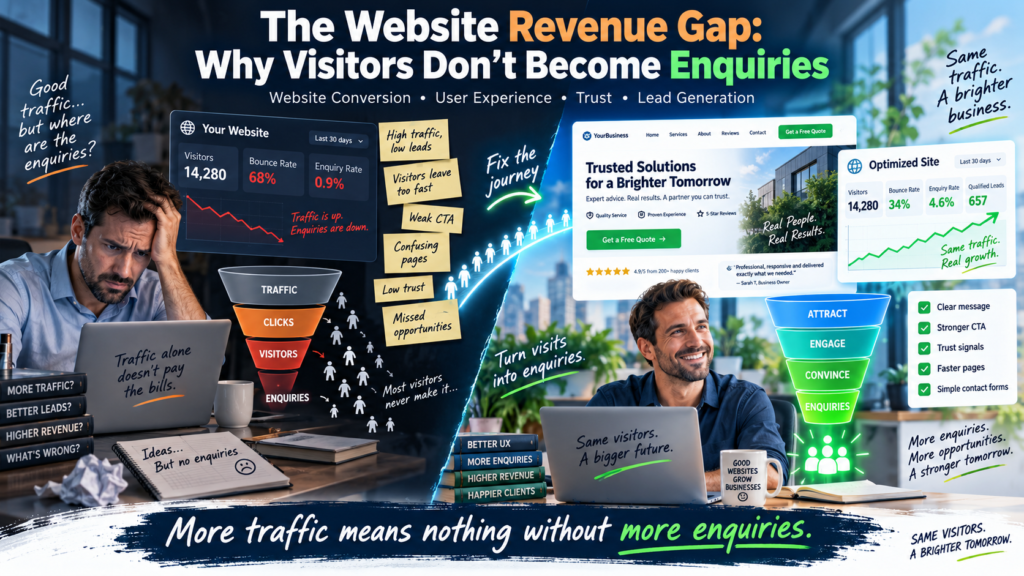
Traffic is not the problem for most Australian business websites the drop-off happens after someone arrives. Visitors don’t become enquiries because the site loses them somewhere in the short journey between “I found this” and “I trust this enough to reach out.” That gap is where the real revenue is lost not in the ad spend that brought the visitor there in the first place.
Where Visitors Don’t Become Enquiries: The Journey, Stage by Stage
Every visitor moves through the same rough sequence before they enquire: they land, they scan for relevance, they look for reasons to trust you, and only then do they decide whether contacting you is worth the effort. Most websites are built around the first stage getting the visitor to land and leave the remaining three almost entirely to chance.
1. Arrival: Does This Page Answer What I Searched For?
If the page doesn’t immediately confirm the visitor is in the right place matching their search intent in the headline and first few lines they bounce before anything else has a chance to work.
2. Relevance: Is This Actually For Me?
Generic messaging (“we deliver quality solutions”) fails here. Visitors are scanning for signs the business understands their specific situation, industry, or problem not a broad claim that could apply to anyone.
3. Trust: Can I Believe What This Page Is Telling Me?
This is the stage most business websites skip almost entirely. Visitors look for evidence reviews, real examples, transparent pricing signals, clear business details before they’ll consider the next step. Without it, even a well-matched, well-written page stalls here.
4. Decision: Is Enquiring Worth the Effort?
At the final stage, friction decides the outcome. A long form, an unclear next step, or no visible way to make quick contact loses visitors who were, right up until that point, ready to reach out.
The table below maps each stage to its most common failure point:
| Journey Stage | What the Visitor Is Asking | Most Common Failure |
| Arrival | “Is this the right page?” | Headline doesn’t match search intent |
| Relevance | “Is this actually for me?” | Generic, one-size-fits-all messaging |
| Trust | “Can I believe this?” | No proof: reviews, examples, or transparency |
| Decision | “Is it worth enquiring?” | Long forms, unclear CTA, high friction |
How to Close the Website Revenue Gap

Match the Headline to the Search Intent That Brought Them There
- Audit your top landing pages against the actual search terms driving traffic to them.
- Rewrite headlines to mirror the visitor’s language, not internal company language.
Add Specific, Visible Trust Signals
- Feature real client outcomes, reviews, or case studies above the fold, not buried on a separate page.
- Make contact details, business credentials, and pricing signals easy to find, not hidden.
Remove Friction From the Final Step
- Shorten enquiry forms to the minimum fields actually needed to follow up.
- Offer a fast alternative to a form a click-to-call number or short response-time promise.
Where This Shows Up Across Australia
The gap looks the same whether it’s a tradie’s site in Perth losing local searchers at the trust stage, a professional services site in Sydney’s CBD losing enquiries to a clunky contact form, or a retailer in Brisbane whose paid traffic lands on a page that doesn’t match what the ad promised.
| City | Common Traffic Source | Where Enquiries Are Usually Lost |
| Sydney | Paid search, B2B enquiries | Weak trust signals on service pages |
| Melbourne | Organic and social traffic | Generic messaging that doesn’t match intent |
| Brisbane | Local search and Google Maps | Headline/ad mismatch on landing pages |
| Perth | Local search, trades enquiries | Long, high-friction enquiry forms |
| Adelaide | Organic search | No visible proof or reviews on key pages |
| Canberra | Referral and direct traffic | Unclear next step or call-to-action |
Where to Get This Diagnosed and Fixed
Closing this gap starts with mapping your actual visitor journey against these four stages, not guessing which one is broken. Website Design & Development and Custom Web Applications both build journey-stage clarity into new and rebuilt sites, while Ecommerce Development applies the same thinking to product and checkout pages. For a full breakdown of where revenue is quietly lost across the funnel, see How Much Revenue Is Your Website Losing Every Month? and The 7 Conversion Killers Hidden on Most Business Websites.
This journey-stage breakdown reflects long-standing UX research: Nielsen Norman Group’s usability research has repeatedly found that visible trust signals and clarity of purpose are among the strongest predictors of whether a visitor takes the next step on a website, well before design polish or page speed enter the picture.
Frequently Asked Questions
Why is my website getting traffic but not enquiries?
Most often the drop-off happens after arrival in relevance, trust, or friction at the final step rather than in the traffic itself. Mapping the visitor journey against those stages usually reveals where.
What’s the single biggest fix for low website enquiries?
Visible, specific trust signals real reviews, examples, and transparency combined with a low-friction way to make contact, tend to move the needle fastest.
Is this different from a general conversion rate optimisation audit?
It’s related but more specific: rather than listing generic conversion problems, it maps exactly which stage of the visitor’s decision journey is breaking down, so fixes target the actual point of loss.
Final Thought
The traffic your marketing generates is doing its job. The website’s job is to carry that visitor through relevance, trust, and a low-friction decision and most sites only handle the first of those three well. Get in touch with Website Design & Development to map your own visitor journey and find out exactly where enquiries are slipping away.