


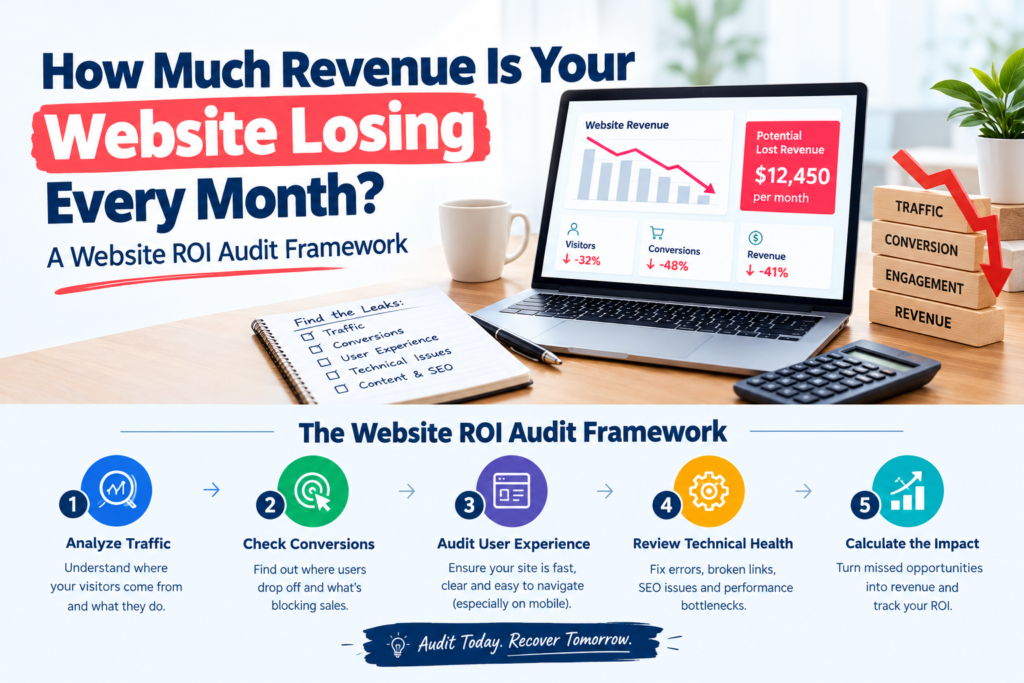
Most businesses have never run a website ROI audit which means most businesses have no idea how much revenue their website is quietly losing every month. A slow page, a weak call to action, or a broken mobile checkout doesn’t show up as a line item on a profit and loss statement, but it shows up in every visitor who leaves without converting. This guide gives you a practical website ROI audit framework you can run yourself, with the six most common revenue leaks and how to estimate what each one is costing you.
This framework is written for Australian business owners and marketing teams in Sydney, Melbourne, Brisbane, Perth, Adelaide and Canberra who want a number, not a guess, before deciding what to fix first.
What Is a Website ROI Audit?
A website ROI audit is a structured review that connects website performance metrics traffic, conversion rate, page speed, mobile experience directly to estimated monthly revenue loss. Instead of a generic “your website needs work” assessment, a proper website ROI audit puts a dollar figure against each problem so you can prioritise fixes by financial impact, not guesswork.
The core formula behind every website ROI audit is simple:
Monthly Revenue Loss = Monthly Visitors × Conversion Rate Gap × Average Customer Value
The 6 Revenue Leaks Framework
Every website ROI audit we run at Web Development Company uncovers the same six categories of revenue leak. Below is what each one costs and how to estimate it.
1. The Traffic Leak Losing Visitors Before They Ever Land
If your site ranks poorly or loads too slowly to be indexed effectively, you’re losing potential customers before the website ROI audit even reaches the conversion stage. Poor Core Web Vitals and thin content directly suppress organic visibility.
See our Core Web Vitals guide for the exact thresholds Google uses to rank and demote websites.
2. The Conversion Leak Traffic Arrives But Doesn’t Act
This is the most common leak uncovered in a website ROI audit: healthy traffic, weak conversion rate. We cover the full breakdown of this problem in Why Your Website Gets Traffic But No Leads usually driven by unclear CTAs, cluttered layouts, or a mismatch between what the page promises and what the visitor is searching for.
3. The Speed Leak Every Second Costs Revenue
Site speed has a direct, measurable relationship with revenue. Deloitte’s “Milliseconds Make Millions” research found that a 0.1 second improvement in mobile site speed can meaningfully lift conversion rates and average order value across retail and other sectors meaning every second of unnecessary load time in your website ROI audit converts directly into lost revenue.
4. The Mobile Leak Losing Half Your Audience Silently
With most Australian traffic now arriving on mobile, a site that isn’t fully optimised for smaller screens, thumb-friendly navigation, and mobile checkout flows loses a disproportionate share of potential customers without ever showing up as an obvious “broken” page.
5. The Trust Leak Visitors Who Convert Elsewhere
Missing reviews, no visible business details, outdated design, or a lack of security signals (SSL, payment badges) quietly push cautious buyers to a competitor. This leak rarely gets flagged in a generic website review, but it’s a consistent finding in a full website ROI audit.
6. The Follow-Up Leak Leads That Are Never Converted to Sales
Even a well-converting website loses revenue if enquiries aren’t followed up quickly or consistently. This leak sits just outside the website itself but is essential to include in a complete website ROI audit, since it determines whether captured leads ever become paying customers.
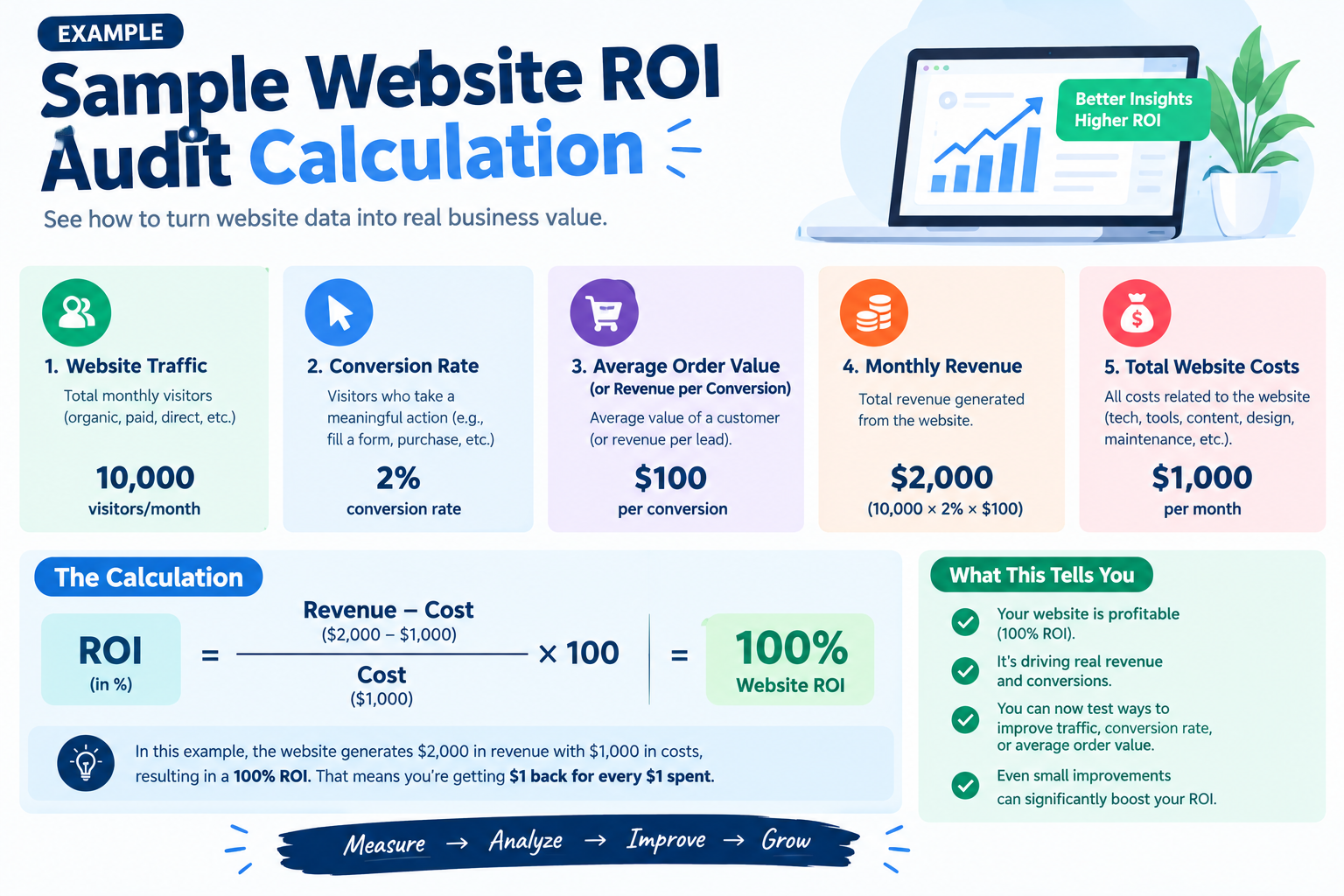
Sample Website ROI Audit Calculation
Here’s an illustrative example of how the leaks translate into a dollar figure for a business with 5,000 monthly visitors and a $2,000 average customer value:
| Revenue Leak | Estimated Impact | Monthly Revenue Loss (Example) |
| Traffic Leak (poor rankings/speed) | -15% potential visitors | $3,000–$6,000 |
| Conversion Leak (weak CTAs/layout) | -1.5% conversion rate | $2,500–$5,000 |
| Speed Leak (slow load times) | -0.5% conversion rate | $1,000–$2,000 |
| Mobile Leak (poor mobile UX) | -1% conversion rate | $1,500–$3,000 |
| Trust Leak (missing signals) | -0.5% conversion rate | $1,000–$1,500 |
| Follow-Up Leak (slow response) | -20% lead-to-sale rate | $2,000–$4,000 |
Actual figures vary by industry, traffic volume and average order value the point of a website ROI audit is to calculate your own numbers, not rely on industry averages.
How to Run Your Own Website ROI Audit: Step by Step
- Pull your last 3 months of traffic, conversion rate and average customer value from analytics
- Run a Core Web Vitals check on your top landing pages
- Test your site on a mobile device end-to-end, including checkout or enquiry forms
- Review your homepage and top landing pages for a single, clear call to action
- Check for visible trust signals reviews, security badges, contact details
- Time how long it takes your team to follow up on a test enquiry
- Apply the revenue loss formula to each leak you find
Website ROI Audit Opportunities Across Australia
Every business loses revenue through these leaks, but competitive pressure makes fixing them more urgent in some markets than others:
- Sydney — highest competition; conversion and speed leaks cost the most per visitor
- Melbourne — dense e-commerce and services competition; trust leaks are especially costly
- Brisbane — fast-growing market; mobile leaks matter as traffic shifts to mobile-first
- Perth — less saturated in many sectors; fixing traffic leaks compounds quickly
- Adelaide — mid-level competition; follow-up leaks are often the biggest opportunity
- Canberra — service-heavy market; trust and clarity leaks carry more weight
Frequently Asked Questions
How often should I run a website ROI audit?
Quarterly is a reasonable baseline, with a full audit after any major traffic drop, redesign, or conversion rate change.
What’s the fastest leak to fix?
The conversion leak usually a CTA, layout or messaging fix often shows results within weeks. See The 7 Conversion Killers Hidden on Most Business Websites for the most common culprits.
Do I need a developer to run a website ROI audit?
You can estimate the numbers yourself using analytics, but fixing the underlying issues speed, mobile UX, custom functionality usually needs a web development team.
Does this apply to e-commerce sites too?
Yes e-commerce sites often see the largest revenue impact from speed and mobile leaks. See our e-commerce development services for platform-specific fixes.
Find Out What Your Website Is Really Costing You
A website ROI audit turns vague concerns about performance into a clear, prioritised, dollar-based action plan. Contact our team for a free website ROI audit across Sydney, Melbourne, Brisbane, Perth, Adelaide and Canberra.