
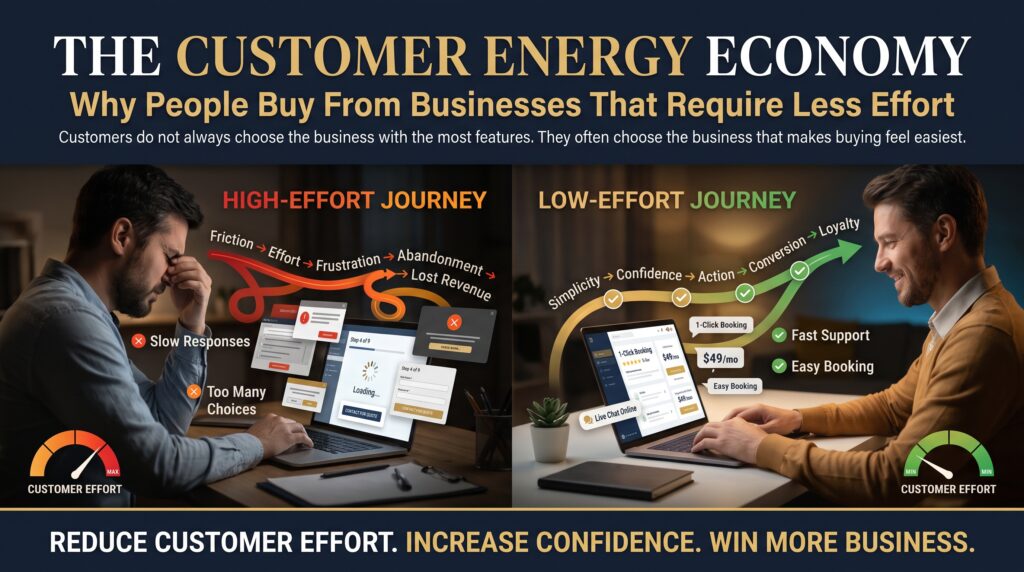


The customer hesitation tax is the hidden price your business pays every time a buyer pauses, doubts or walks away from a purchase they were close to making. You never see it on an invoice or a profit and loss statement, yet it shows up as abandoned carts, unanswered quote requests, longer sales cycles and ad spend that never turns into revenue. For many Australian businesses, it is one of the biggest leaks in the whole sales process.
The frustrating part is that most of this hesitation is not about your product or your price. It is about small moments of doubt on your website: a page that loads slowly, a price that is hard to find, a checkout that asks for too much, a phone number that is hard to tap. In this guide, we explain what the customer hesitation tax is, how to estimate what it costs you, and eight practical fixes you can start on this month.
Key Takeaways
- The customer hesitation tax is lost revenue caused by doubt, friction and uncertainty during the buying journey.
- Most hesitation comes from seven website issues: speed, clarity, price, proof, mobile usability, checkout friction and trust.
- You can estimate your own tax with a simple formula using visitors, conversion rate and average order value.
- Small improvements in speed, messaging and checkout design can add up to meaningful monthly gains.
What Is the Customer Hesitation Tax?
Think of it as a toll booth between interest and purchase. Every visitor who arrives on your site has some intent. They searched for something, clicked an ad or followed a recommendation. To become a customer, they have to pass through a series of small decisions, and at each one a little doubt can cost you the sale. The sum of all those lost sales is your customer hesitation tax.
Psychology helps explain why this happens. Daniel Kahneman and Amos Tversky’s work on loss aversion shows that people tend to weigh potential losses more heavily than equivalent gains. For an online buyer, the “loss” might be wasting money, receiving the wrong product, being charged unexpected fees or having their card details mishandled. When the risk feels bigger than the benefit, they hesitate, and a hesitating customer is very likely to close the tab.
Importantly, the customer hesitation tax is paid even by good businesses. A company can have great products, friendly staff and fair pricing and still lose sales because the website quietly raises questions it never answers.
Seven Website Doubts That Create the Customer Hesitation Tax
1. Slow loading pages
Speed is a trust signal. A page that crawls makes a business feel unreliable before a single word is read. Google’s Core Web Vitals give clear targets: aim for Largest Contentful Paint within 2.5 seconds, Interaction to Next Paint under 200 milliseconds and Cumulative Layout Shift below 0.1. Heavy images, bloated plugins and cheap hosting are the usual culprits.
2. An unclear offer
If a visitor cannot tell within a few seconds what you sell, who it is for and what to do next, they will not stay to work it out. Vague headlines such as “Innovative digital solutions” add to the customer hesitation tax. Plain, specific wording reduces it.
3. Hidden or confusing pricing
Nothing creates doubt faster than surprise costs at the final step. Even if you cannot publish fixed prices, show a starting price, a range or a clear explanation of how pricing works. Be upfront about shipping, GST and any other charges before checkout. The ACCC publishes guidance for Australian businesses on honest pricing and advertising practices.
4. Missing or weak social proof
Buyers want evidence that others have done this and been happy. Genuine reviews, named testimonials, case studies, recognisable logos and real photos all lower perceived risk. Generic stock images and unnamed quotes do the opposite.
5. A poor mobile experience
Most browsing now happens on phones. Tiny buttons, pop-ups that cover the screen, text that needs pinching and forms that are hard to fill in all increase the customer hesitation tax. Mobile design is not a smaller version of desktop. It deserves its own thought.
6. Checkout and form friction
Long forms, forced account creation, limited payment options and unclear error messages push people away at the last moment. Research from the Baymard Institute has long reported that average cart abandonment sits at around 70 per cent, and that unexpected costs, account requirements and complicated checkouts are among the commonly cited reasons.
7. Weak trust and security signals
Visitors look for HTTPS, recognised payment methods, clear privacy and returns policies, real contact details and fast support. The Australian Cyber Security Centre at cyber.gov.au offers practical advice on keeping business websites and customer data secure, which supports both safety and credibility.
How to Calculate Your Customer Hesitation Tax
You do not need complex software to get a first estimate. Use this simple formula:
Customer hesitation tax = (additional conversions you could win) × average order value
Here is an illustrative example. Suppose your online store gets 12,000 visitors a month, converts at 2 per cent and has an average order value of $150. That is 240 orders and $36,000 in monthly revenue. If fixing speed, clarity and checkout friction lifts your conversion rate to 2.5 per cent, you would earn 300 orders and $45,000. The difference, $9,000 a month or $108,000 a year, is the customer hesitation tax you were paying. These numbers are examples only, so plug in your own data from Google Analytics 4 and your store platform.
For service businesses, use enquiries instead of orders. Multiply the extra enquiries by your close rate and your average job value to see what doubt is costing you.
The Hidden Costs Beyond Lost Sales
The customer hesitation tax is bigger than the revenue you can count. It also affects:
- Advertising efficiency: when visitors leave, every click you paid for becomes more expensive per sale.
- Discounting: businesses often cut prices to overcome doubt that a clearer page could have solved for free.
- Support workload: unanswered questions turn into emails and phone calls your team has to handle.
- Sales cycle length: hesitant buyers take longer to decide, which hurts cash flow.
- Search performance: Google’s guidance on helpful, people-first content rewards pages that satisfy users, and pages that frustrate people tend to underperform over time.
8 Ways to Reduce the Customer Hesitation Tax

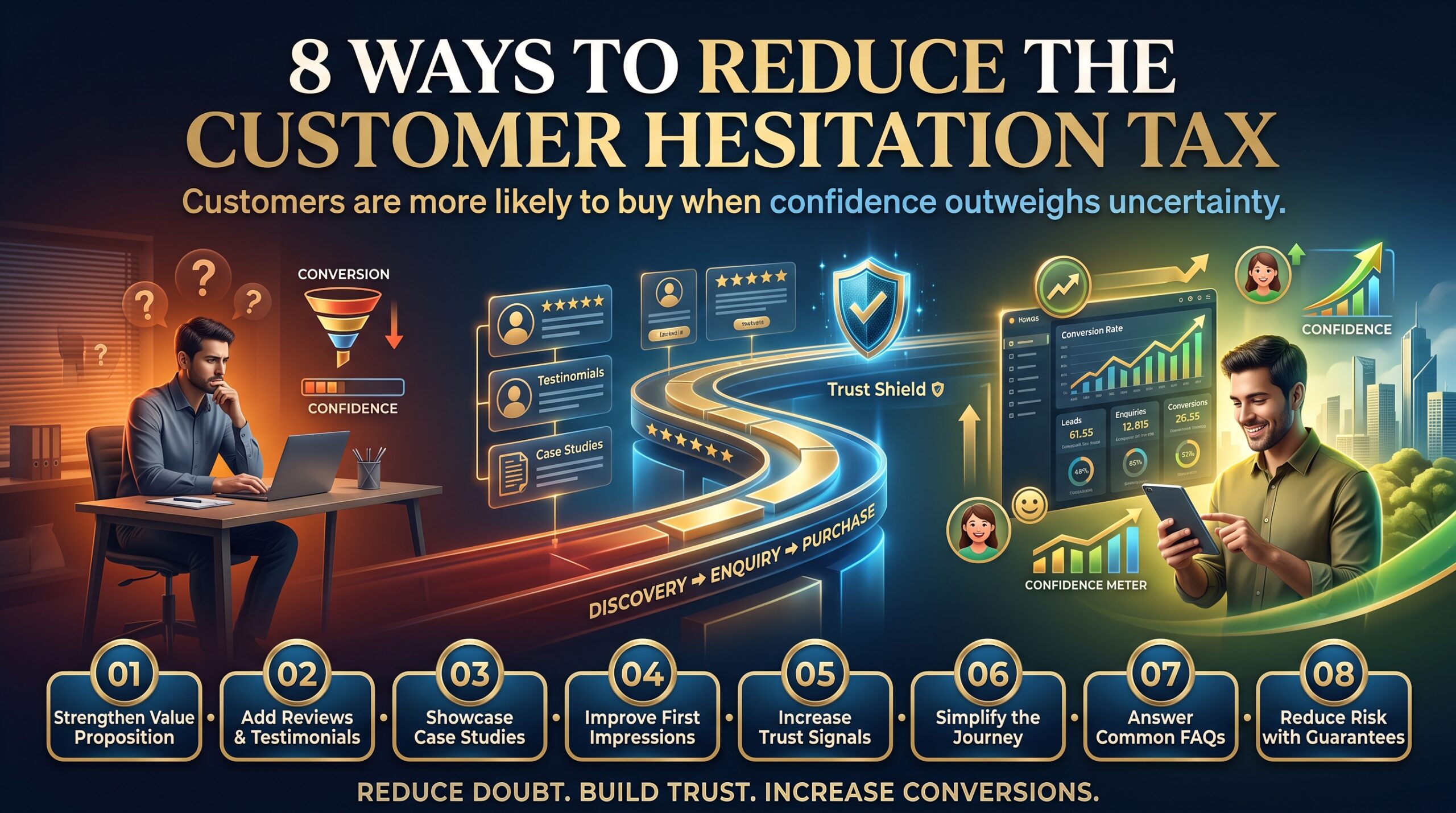
1. Make speed a priority
Compress and properly size images, use modern formats such as WebP, limit unnecessary scripts, choose quality hosting and use caching. Test with Google PageSpeed Insights and fix the biggest issues first.
2. Rewrite your headline and first screen
State what you do, who you serve and what the next step is. Place a clear call to action where visitors can see it without scrolling.
3. Show pricing and delivery details early
Reveal costs before checkout, not during it. Explain shipping times, returns and warranties in simple language.
4. Add proof where decisions are made
Place reviews beside buy buttons and enquiry forms, not hidden on a separate page. Use real names, photos and specific results wherever you can.
5. Design mobile first
Use large tap targets, sticky call buttons, short forms and readable text. Test on real devices rather than only on a resized desktop browser.
6. Simplify checkout
Offer guest checkout, show progress, support wallets such as Apple Pay, Google Pay and PayPal, and make error messages human and helpful.
7. Build visible trust
Show secure payment badges only where they are genuine, publish easy-to-find contact details, and answer common questions on a clear FAQ page. You can see how we handle this on our FAQs page.
8. Measure, test and repeat
Use heatmaps, session recordings and funnel reports to see where people stall. Make one change at a time, test it and keep what works. Reducing the customer hesitation tax is an ongoing process, not a one-off project.
Customer Hesitation Tax in Ecommerce: Shopify, WooCommerce and WordPress
Online stores feel the customer hesitation tax most sharply because the buying journey has so many steps. The platform you choose matters less than how well it is set up, but each has its own common pitfalls.
- Shopify: theme bloat and too many apps slow stores down. Our Shopify development services focus on speed, conversion and clean app integrations.
- WooCommerce: flexible but easy to overload. Our WooCommerce development team tunes performance, checkout flow and product pages.
- WordPress: great for content-led sites when built well. See our WordPress development services.
- Outdated stores: if your site feels dated, an ecommerce website redesign or a careful migration can remove years of accumulated friction.
- Small businesses: a lean, focused build often converts better than a complicated one. Explore small business website development.
Once the experience is smooth, ecommerce SEO helps bring in more qualified visitors. You can browse everything we offer on our services page, or learn more about our web design and development approach.
The Customer Hesitation Tax Across Australian Cities
Local expectations vary, but doubt is universal. Whether your customers are in Sydney, Melbourne, Brisbane, Adelaide, Perth or Canberra, they judge your business within seconds. See our locations page for how we support each market.
- Sydney: a crowded, competitive market where fast, polished sites stand out. See web development in Sydney.
- Melbourne: design-savvy buyers who value quality and clear brand stories. See web development in Melbourne.
- Brisbane: strong growth in services and retail, with customers who expect easy mobile experiences. See web development in Brisbane.
- Adelaide: loyal local audiences who respond to trust and community proof. See web development in Adelaide.
- Perth: resources, trades and retail businesses that need reliable, fast sites. See web development in Perth.
- Canberra: detail-oriented buyers, including government suppliers, who expect clarity and security. See web development in Canberra.
Level Up Your Team: Digital Marketing Training
A good website works best when your team understands how traffic, content and conversion fit together. If you want your staff to build those skills, explore this digital marketing course, which covers practical channels such as search, social and paid media. Better knowledge inside your business makes it easier to spot and reduce the customer hesitation tax over time.
A Ten-Minute Customer Hesitation Tax Audit
Open your website on your phone, pretend you are a first-time buyer, and ask yourself:
- Does the page load in about two to three seconds?
- Is it obvious what you offer and what to do next?
- Can I find the price, shipping and returns without hunting?
- Do I see real proof from real customers?
- Is the checkout or enquiry form short and simple?
- Do I feel safe entering my details?
Every “no” is a doubt your visitors are feeling too. Fix the quick wins first, then measure your conversion rate over the following weeks to see how much of the customer hesitation tax you have recovered.
Frequently Asked Questions About the Customer Hesitation Tax
What is the customer hesitation tax?
It is the revenue a business loses when buyers feel doubt, friction or uncertainty and leave without purchasing. It is not a literal tax, but a hidden cost of a confusing or untrustworthy buying experience.
How do I calculate the customer hesitation tax for my website?
Estimate how many extra conversions you could win by removing friction, then multiply by your average order value or job value. For example, 60 extra orders at $150 equals $9,000 a month.
What causes customers to hesitate on a website?
Common causes include slow pages, unclear messaging, hidden costs, weak reviews, poor mobile design, long checkouts and missing trust signals such as secure payments and clear policies.
Does website speed really affect sales?
Yes. Slow pages frustrate users and weaken trust, and Google uses page experience signals such as Core Web Vitals as part of its guidance for quality sites. Faster pages generally support better engagement and conversion.
Can a new website reduce the customer hesitation tax?
Often, yes. A rebuild or redesign focused on speed, clear messaging, mobile usability and a streamlined checkout can remove many of the doubts that cost you sales.
Which platform is best for reducing hesitation: Shopify, WooCommerce or WordPress?
The best platform depends on your products, team and budget. Any of them can convert well when built properly, so focus on performance, clarity and a smooth checkout rather than the platform name alone.
Final Thoughts: Stop Paying the Tax
Every business pays some customer hesitation tax, but you do not have to keep paying the full amount. By making your site faster, clearer, safer and easier to use, you remove the doubts that stand between interest and action, and you turn more of the traffic you already have into revenue.
If you would like help finding and fixing the biggest sources of doubt on your website, get a free quote or learn more about our team. We build fast, conversion-focused websites for businesses across Sydney, Melbourne, Brisbane, Adelaide, Perth and Canberra, and you can read more helpful guides on our blog.