


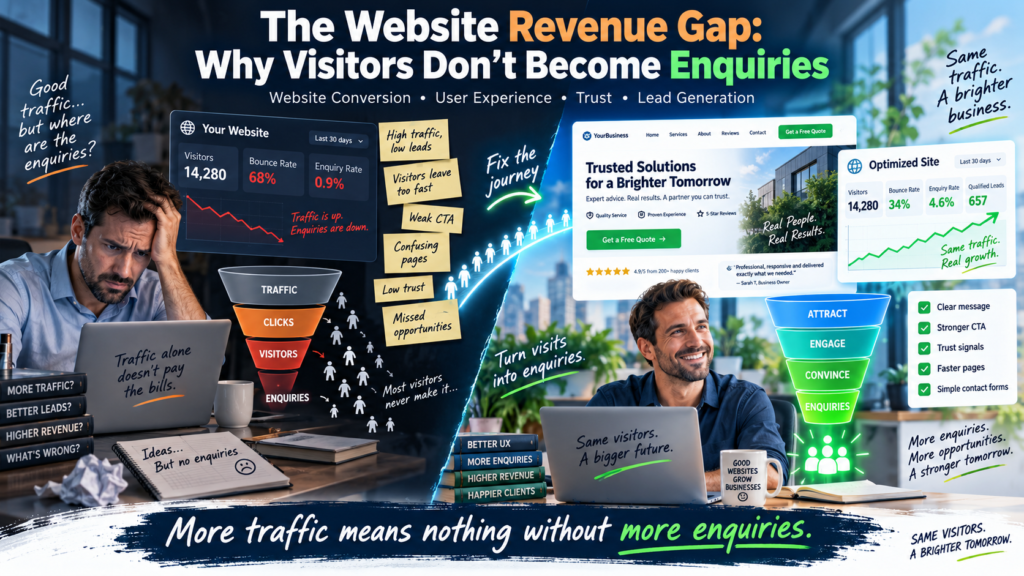
Your website conversion rate is quietly telling you something you probably haven’t noticed: people are showing up, looking around, and leaving without buying, calling, or enquiring. Traffic looks healthy in analytics. Ad spend is working. And yet enquiries stay flat. This is one of the most common and most invisible problems in Australian business websites today, and it rarely gets fixed because nobody realises it’s happening in the first place.
A website doesn’t have to look broken to be broken. It can look perfectly professional and still be leaking customers every single day through small, unglamorous problems: a slow load, a confusing menu, a button in the wrong place. None of these show up as an error message. They just show up as a lower website conversion rate, month after month, until someone finally asks why.
The Silent Reasons Your Website Conversion Rate Is Low
Most business owners assume a website problem will be obvious broken links, an ugly layout, outdated branding. In reality, the biggest conversion killers are the ones visitors never consciously notice, they just quietly leave. As we explored in Why Every Business Needs a Professional Website, a website’s job isn’t to exist it’s to convert. A site that looks fine but doesn’t guide people toward action is functioning as a digital brochure, not a sales tool.
Slow Load Times Are Quietly Costing You Customers
Speed is the single most underestimated driver of website conversion rate. Independent research compiling data from Google, Akamai, and Portent shows that more than half of mobile visitors abandon a site that takes longer than three seconds to load, and that conversion rates for fast-loading ecommerce sites can run more than double those of slow ones. Every extra second of load time is a direct, measurable leak in your customer pipeline and most business owners have no idea their site is even slow, because it loads fine on their office Wi-Fi.
Poor Mobile UX Sends Customers to Competitors
With the majority of traffic now arriving on mobile, a site that was only ever tested on desktop is losing customers before they even reach your content. Cramped buttons, text that requires zooming, and forms that are painful to fill out on a small screen all push visitors toward a competitor’s site that simply feels easier to use.
Confusing Navigation and Weak CTAs Kill Conversions
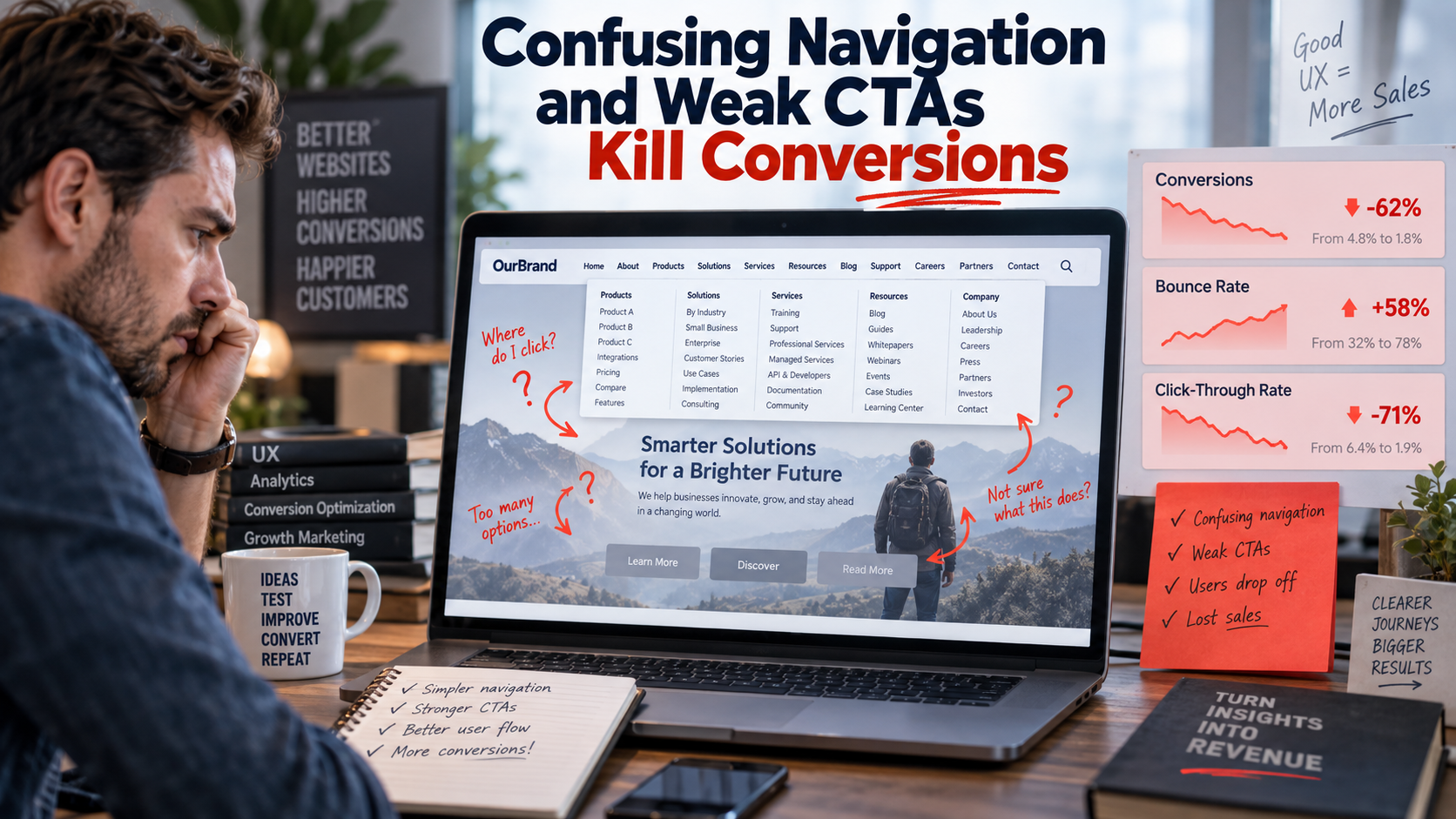
If a visitor has to think about where to click next, most won’t bother they’ll leave. A strong website conversion rate depends on obvious, well-placed calls to action, a logical page structure, and messaging that answers “why should I choose you?” within seconds of the page loading.
What a High-Converting Website Actually Looks Like
- Loads in under two seconds on both desktop and mobile connections
- Uses a clear, single primary call to action per page not five competing options
- Shows pricing, process, or next steps without forcing visitors to dig for them
- Is built mobile-first, not adapted from a desktop layout after the fact
- Loads on a scalable, properly maintained CMS or ecommerce platform
How We Fix Website Conversion Rate Issues
Improving website conversion rate usually isn’t about a full rebuild it’s about identifying the specific friction points losing you customers. Our web design and development work focuses on speed, mobile UX, and conversion-led layout, while our ecommerce web services cover platforms like Shopify development and WooCommerce development for businesses selling online. For the technical fundamentals, Google’s own Core Web Vitals guidance outlines exactly which speed and stability metrics affect both user experience and search visibility.
If you’re weighing up how ecommerce design affects sales specifically, our article What Is Ecommerce Web Design & Why It Matters breaks that down further, and Top Web Development Trends for 2026 covers the current standards buyers now expect from a business website.
Web Development Services Across Australia
We build and repair conversion-focused websites for businesses across major Australian cities:
- Web development services in Melbourne
- Web development services in Sydney
- Web development services in Brisbane
- Web development services in Perth
- Web development services in Adelaide
- Web development services in Canberra
Frequently Asked Questions
How do I know if my website conversion rate is actually a problem?
If your traffic is steady or growing but enquiries, calls, or sales aren’t following the same trend, that gap is the clearest sign. A free technical and UX audit can usually pinpoint exactly where visitors are dropping off.
Is a slow website really losing me customers, or is that overstated?
It’s not overstated it’s one of the most consistently measured effects in web performance research. Load-time delays of even one to two seconds correlate with meaningfully lower conversion rates across ecommerce and lead-generation sites alike.
Do I need a full website rebuild to fix a low conversion rate?
Not always. Many website conversion rate issues can be fixed by improving speed, mobile UX, and call-to-action placement without a ground-up rebuild. A rebuild becomes worthwhile when the underlying platform itself is outdated, insecure, or unable to scale.
Final Thoughts
A website that looks fine can still be losing you customers every day, quietly, without a single error message to warn you. Fixing your website conversion rate usually starts with a proper audit of speed, mobile experience, and page structure not a guess. Explore our full web development services or get a free quote from our team to find out exactly where your site is leaking customers.