
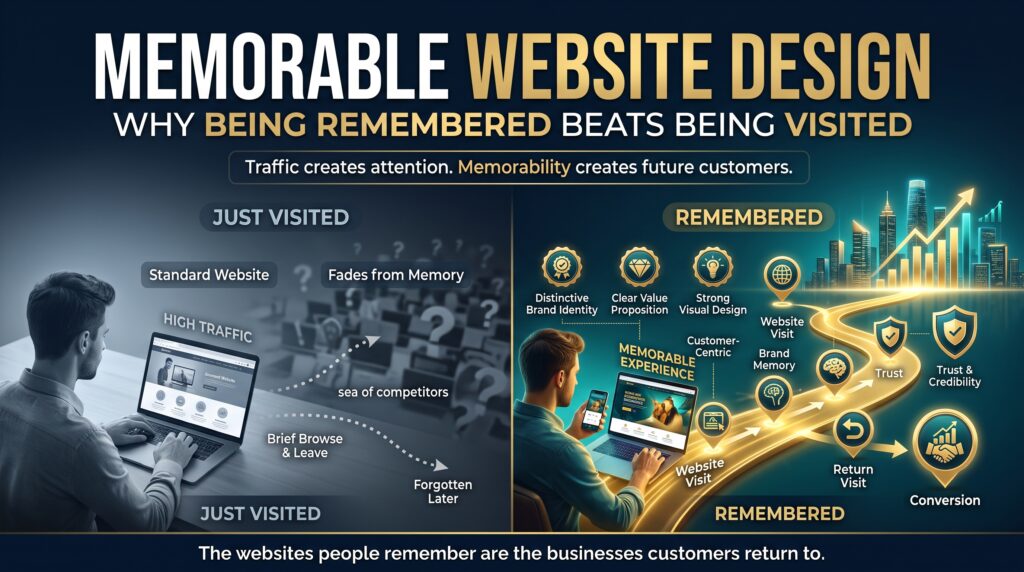

Memorable website design is quietly becoming one of the most valuable assets a business can own. Most companies still measure their website by visits: how many people arrived, from where, and how long they stayed. But a visit is a one-time event. What decides whether a visitor becomes a customer next week, next month or next year is something far harder to count: whether they remember you.
We call this the digital memory economy. In a world where every buyer has a dozen tabs open and a phone full of notifications, attention is cheap and recall is expensive. The businesses that win are not the ones with the most traffic. They are the ones people can name, find again and describe to a friend. This guide explains why recall beats raw visits, what makes a site memorable, and how Australian businesses can build for it.
What Is the Digital Memory Economy?
It’s the idea that online value increasingly depends on being remembered rather than merely discovered. Without memorable website design, a visitor who forgets you after one session is, for practical purposes, a visitor you have to pay for again. A visitor who remembers you may search for your name, type your address directly, return through a bookmark or recommend you to someone else, all at no extra cost.
That’s why recall shows up in the numbers that quietly drive profit: branded search, direct traffic, returning visitors and referrals. These are the signals of a business that sits in people’s heads. Strong memorable website design is one of the few levers that influences all four, which is why we treat it as a core business asset.
Visits Versus Memory: Why the Difference Matters
| Being visited | Being remembered | |
| What it measures | Sessions and page views | Return visits, branded searches, referrals |
| Cost to repeat | You pay again through ads or SEO effort | Often free, driven by recall |
| Visitor intent | Browsing and comparing | Already familiar and more ready to act |
| Competitive risk | High: easily swapped for the next result | Lower: people look for you by name |
| Long-term value | Resets every month | Compounds over time |
Neither side is optional. You still need visitors to be remembered. But a website designed only to attract visits is built for the shallow end of the funnel, and it shows in how quickly people forget it.
What Makes a Website Memorable?
People rarely remember pages. They remember impressions: how a site looked, how fast it felt and whether it helped. Memorable website design tends to share a handful of qualities.
- A distinct visual identity. Consistent colours, type and imagery that look like you and no one else. Generic templates blur together in memory.
- One clear idea. Visitors should be able to repeat what you do in a single sentence after thirty seconds on the homepage.
- Speed and smoothness. People remember how a site made them feel. A fast, easy experience leaves a quietly positive impression, and a slow one leaves a sour one.
- Real personality. Specific words, real photography and a recognisable tone beat polished but empty copy.
- Something worth returning for. A useful guide, calculator, checklist or resource gives people a reason to come back.
- Frictionless mobile use. Most recall is formed on a phone, often in a hurry. If it works well there, it gets remembered.
Why Memorable Website Design Beats Another Traffic Campaign
When growth stalls, the common reaction is to buy more traffic. Sometimes that’s right. But pouring visitors into a forgettable website is like filling a bucket with a slow leak. Each visitor arrives, glances around, leaves and forgets.
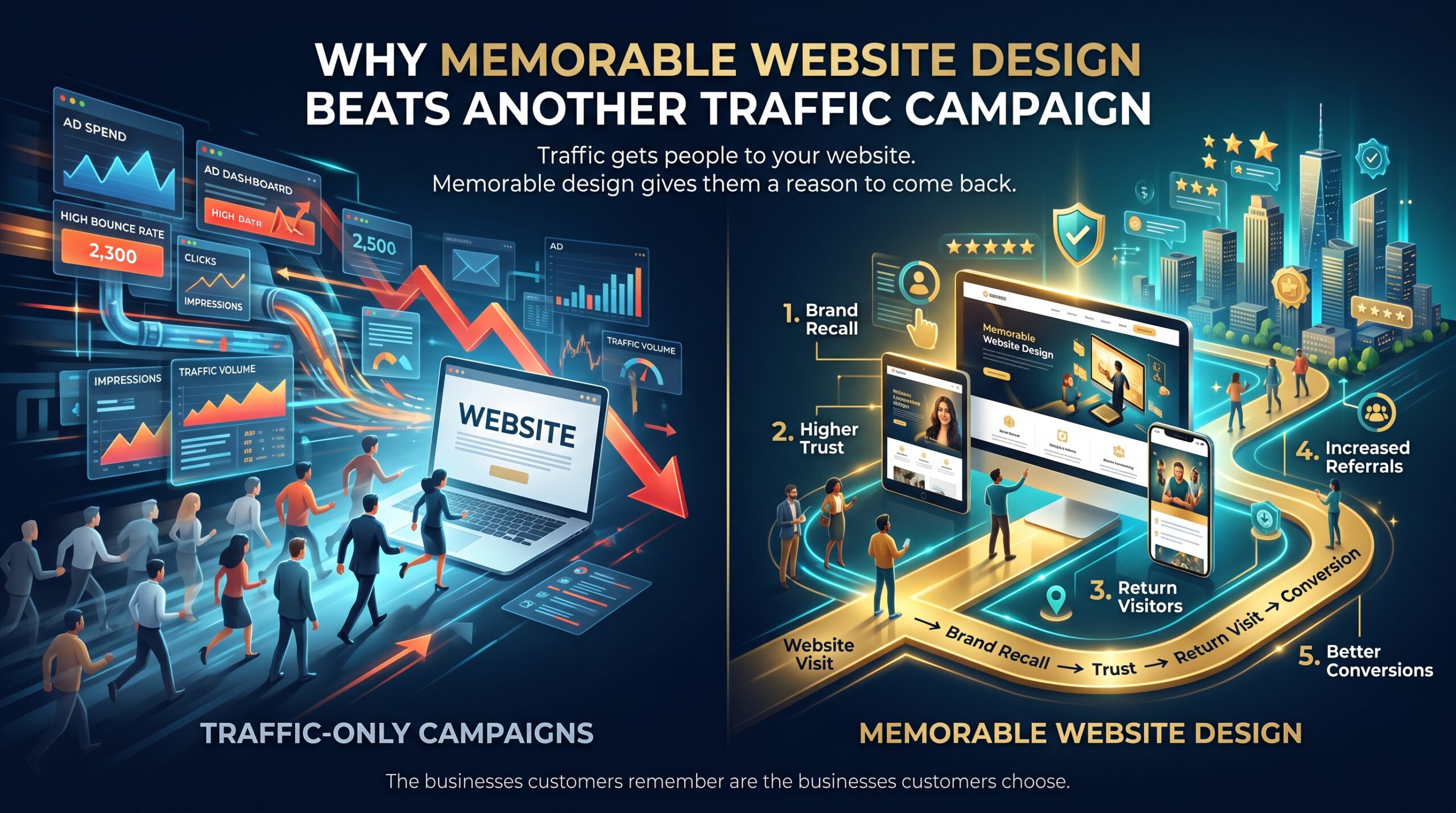
Investing in memorable website design changes the maths. The same visitors are more likely to return, search for you later and mention you to colleagues. Your SEO and advertising spend then works harder, because it is feeding a site that people retain rather than one they bounce from. Over a year, that difference can be larger than any single campaign.
A Quick Example: Same Traffic, Different Memory
Imagine two Melbourne tradie businesses, each getting about the same number of monthly visits. The first has a template site with stock photos, a vague headline and a slow mobile experience. The second has a clear one-line promise, real photos of its team on site, fast pages and a short guide on what a job should cost.
After a month, the first business has a spreadsheet of visits and very little else. The second has people searching for its name, returning to the pricing guide and mentioning it to neighbours. The difference isn’t luck or budget. It’s memorable website design doing quiet work in the background, long after each visit ends.
That’s the heart of the digital memory economy: the businesses people remember are the ones that get the second call, the repeat order and the referral.
Building Memory Into Your Website: A Practical Framework
- Define your one-line promise. Write the sentence you want a visitor to repeat. Put it above the fold in plain language.
- Choose a recognisable look. Pick two or three brand colours, a typeface pairing and an image style, then use them everywhere without exception.
- Make speed non-negotiable. Optimise images, hosting and code so pages feel instant. Our web design and development work treats performance as part of the design, not an afterthought.
- Show real people and real work. Replace stock imagery with your team, your projects and your customers where possible.
- Create one return-worthy resource. A guide, tool or template that answers a question your buyers keep asking.
- Capture and nurture. Invite visitors to stay in touch through email or a simple follow-up, so memory is reinforced between visits.
- Measure recall, not only visits. Track branded search, direct traffic and return rate in Google Analytics 4 and Search Console.
None of these steps needs a huge budget. Memorable website design needs consistency and a willingness to be distinctive rather than safe.
Memorable eCommerce: Why Online Stores Need It Most
Online shoppers can switch stores in seconds, which makes recall even more valuable in eCommerce. A store that’s easy to remember gets direct visits, bookmarked carts and word-of-mouth. A store that blends in gets compared on price alone.
Whether you sell through Shopify, WooCommerce or a custom build, the same principles apply: a recognisable identity, a fast and simple checkout, and product pages that feel distinct. Our eCommerce web services cover the full range, including Shopify development, WooCommerce development and WordPress development. If your current store lacks memorable website design, an eCommerce website redesign is often the quickest way to change that, and eCommerce SEO helps the right people find the new version.
How to Measure Whether Your Website Is Being Remembered
Recall can feel abstract, but it leaves clear footprints. Check these four signals every month:
- Branded search volume. Are more people searching for your business name in Google Search Console?
- Direct traffic. Are people typing your address or using bookmarks?
- Returning visitor rate. Is the share of repeat sessions rising in Google Analytics 4?
- Referral and word-of-mouth enquiries. Are new customers saying someone recommended you?
If all four are flat while visits are growing, your site lacks memorable website design and is attracting people but not sticking in their minds. That’s a design and messaging problem, not a traffic problem.
Memorable Website Design Across Australian Cities
Every market rewards memorable website design, but the way recall is built differs by city.
Sydney: Competition is intense, and distinctive branding is often the only real differentiator. See our web development in Sydney.
Melbourne: Creative and design-literate audiences notice craft, so quality and personality count. Explore web development in Melbourne.
Brisbane: Fast-growing local businesses benefit from sites that feel approachable and community-rooted. Check web development in Brisbane.
Perth: Distance from the eastern states makes a strong, memorable online presence especially valuable. Learn about web development in Perth.
Adelaide: Tight-knit business communities mean word-of-mouth travels quickly when the website backs it up. Visit web development in Adelaide.
Canberra: Professional and government audiences value clarity, credibility and accessibility above flash. View web development in Canberra.
See all areas on our locations page.
Common Mistakes That Undermine Memorable Website Design
- Relying on templates without customisation. Visitors can sense when they have seen a site before.
- Trying to say everything. A homepage that explains ten things is remembered as none of them.
- Ignoring speed. Slow pages are remembered, but for the wrong reason.
- Changing the look constantly. Frequent redesigns without consistency erase the recognition you’ve built.
- Measuring only traffic. What you track shapes what you build. Add recall metrics to your reporting.
For more background on what a professional site should do, read why every business needs a professional website and our overview of top web development trends for 2026. You may also like our explainer on why ecommerce web design matters.
Frequently Asked Questions About Memorable Website Design
What is memorable website design?
It’s the practice of building a website with a distinctive identity, clear message and smooth experience, so visitors remember the business and return, search for it by name or recommend it.
Why does being remembered matter more than being visited?
Visits can be bought or borrowed and often reset every month. Recall compounds, bringing repeat visits, branded searches and referrals that cost far less to earn.
How do I know if my website is memorable?
Look at branded search volume, direct traffic, returning visitor rate and referral enquiries. If visits are rising but these aren’t, your site is not sticking.
Does website speed affect how memorable a site is?
Yes. People remember how a site felt to use. Fast, smooth pages leave a positive impression, while slow or clumsy ones leave a negative one.
Can a small business afford memorable website design?
Yes. Distinctiveness comes from clear thinking, consistent branding and good performance more than a large budget. Start with your message, your visual identity and your speed.
Final Thoughts: Build a Website People Can’t Forget
Traffic will always matter, but it’s a rented advantage. Memory is owned. Every visitor who remembers your name, your look and the way your site felt is a customer you didn’t have to buy twice. Memorable website design is how you turn passing attention into lasting recall.
Want a website that gets remembered? Request a free website audit or call 1300 649 299 to talk with our team about the right approach for your business.