
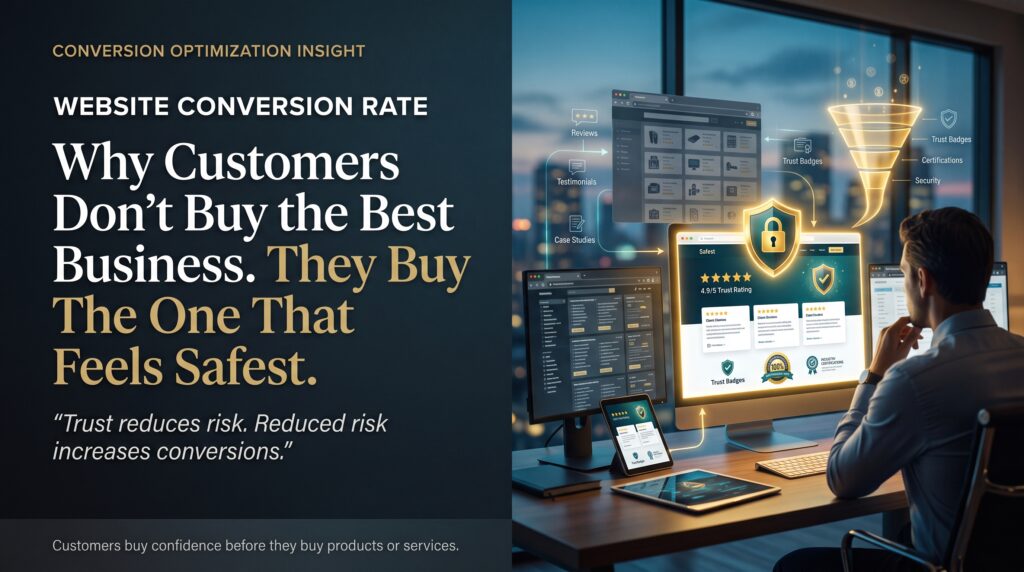
Website conversion rate has less to do with who’s best than most business owners expect. It has far more to do with who feels safest.
Think about how you shop. You open three tabs, skim each site, and in about a minute you’ve made a decision. You didn’t run a quality audit. You chose the one that felt least likely to go wrong. Your own customers do exactly the same thing on your site, and they usually do it before they’ve read a single paragraph.
This guide explains why feeling safe beats being best, the five kinds of risk every visitor weighs, and practical changes that lift your website conversion rate by lowering that risk. It’s written for Australian business owners, marketers and ecommerce managers, from Sydney, Melbourne, Brisbane, Perth, Adelaide or Canberra.
Best Versus Safest: What Really Drives Your Website Conversion Rate
Every business believes it has a quality advantage. The trouble is that visitors can’t verify it. They can’t test your workmanship, read your internal processes or ask your last ten customers how it went. So they look for what they can verify: how the site looks, how it behaves and what evidence is on show.
Call it the safety gap. A quality gap is the real difference between you and a competitor. A safety gap is the difference in how safe each of you feels to choose. If a competitor looks calmer and clearer, they can win the sale even when you’re genuinely better. That’s the hidden reason a good business can have a weak website conversion rate.
The 5 Kinds of Risk Visitors Weigh Before They Convert
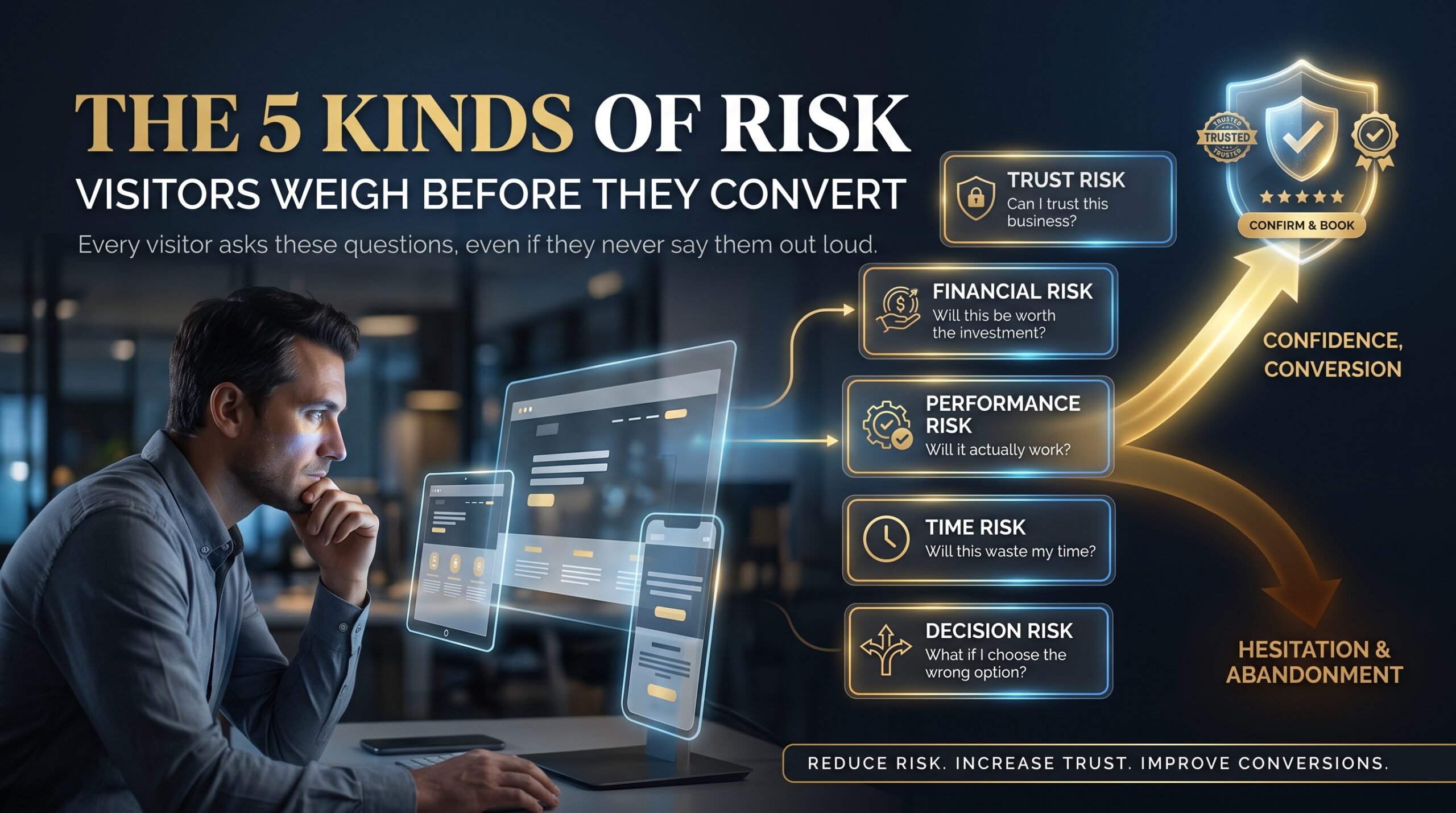
Safety isn’t one thing. Visitors quietly weigh five separate risks, and each one has a website fix.
1. Financial risk: “Will I overpay or lose money?”
People hate surprise costs. Show starting prices, what’s included and what’s extra. Even a short “how pricing works” section removes a lot of fear.
2. Performance risk: “Will this actually work?”
Answer with specific outcomes and named examples. Describe what changed for a customer in plain words. Vague claims make this fear louder.
3. Time risk: “Will this waste my time?”
Make the next step obvious and the process short. Tell visitors how long a quote, a delivery or a reply will take. Confusing menus and long forms feel like wasted hours in advance.
4. Social risk: “Will I look foolish if this goes wrong?”
Buyers choosing for a team or a boss feel this strongly. Recognisable clients, reviews from similar businesses and clear credentials let them justify the decision to others.
5. Privacy risk: “Is my information safe?”
Use HTTPS, a clear privacy policy and secure payment options. The Office of the Australian Information Commissioner explains privacy obligations for businesses, and the Australian Cyber Security Centre offers practical security guidance.
The 5-Second Safety Test Your Website Must Pass
Open your homepage on your phone and look at it for five seconds. Then ask whether a stranger could answer these questions:
- What does this business do?
- Who is it for?
- Is there proof other people trust it?
- What should I do next?
- Does this look like an active, real business?
If any answer is “not sure”, you’ve found a leak in your website conversion rate. Fix those five answers before you spend a dollar on more traffic.
How to Improve Your Website Conversion Rate by Lowering Perceived Risk
Say what happens next
Under every button, add a one-line promise: “We’ll reply within one business day” or “No obligation, just a quote”. Uncertainty about the next step stops more clicks than most designers realise.
Put proof next to the decision
A review beside the enquiry form works harder than a testimonials page nobody visits. Place evidence where hesitation happens.
Make forms short and reversible
Ask only for what you need. Add reassurance like “we never share your details”. A small, low-commitment first step, such as a free audit or a quick call, feels much safer than a hard sell.
Keep the site fast and stable
A slow or jumpy page signals carelessness. Google’s Core Web Vitals give you measurable speed and stability targets. A clean WordPress build makes them easier to hit.
Stay consistent and professional
Mixed fonts, stretched images and outdated pages whisper “unreliable”. Thoughtful web design and development keeps your site looking like one coherent brand.
Respond quickly after the click
Your website conversion rate depends on what happens after the form is submitted, too. A fast, friendly reply confirms the safe impression your site created.
Ecommerce: Where the Safest Choice Wins Even Faster
Online shoppers hand over card details to a business they may never have heard of. That makes ecommerce a safety contest. Clear delivery times, easy returns, recognisable payment options and a calm checkout all lift your website conversion rate, and research from the Baymard Institute on checkout usability is worth reading.
If you sell online, look at WooCommerce development or Shopify development, and consider an ecommerce website redesign if your store feels dated. Pair that with ecommerce SEO so safer, faster pages also attract more of the right visitors. Keep any claims honest too; the ACCC explains the rules for advertising and selling.
A 30-Day Plan to Lift Your Website Conversion Rate
- Days 1–5: Run the 5-second test. Ask three people outside your business to look at your homepage and tell you what they understood.
- Days 6–10: Map your risks. Write down the five risks above and note where your site answers each one, and where it’s silent.
- Days 11–15: Fix the loudest gap. Pick the weakest answer and rewrite that section.
- Days 16–20: Move proof closer. Place reviews, guarantees and credentials beside forms and buy buttons.
- Days 21–25: Shorten the path. Cut form fields, remove extra clicks and add next-step promises.
- Days 26–30: Measure and repeat. Compare enquiries and sales with the previous month, then choose the next gap.
For a deeper look at the proof side, read our companion guide on website trust signals. It lists nine signals that work well alongside this plan.
Website Conversion Rate for Australian Businesses Across Cities
Local context adds to the sense of safety. A Brisbane trades business, a Melbourne retailer and a Perth professional service all benefit from local phone numbers, suburb references and reviews from nearby customers. Our location pages cover Sydney, Melbourne, Brisbane, Perth, Adelaide or Canberra, and the locations page lists them all.
Smaller businesses can start with small business website development, then expand as the numbers justify it. See the full range of web development services, and consider pairing design with web design and SEO support so more qualified visitors arrive in the first place.
Website Conversion Rate FAQs
What is a good website conversion rate?
It varies by industry, traffic source and offer, so the most useful benchmark is your own past performance. Track it monthly and aim to improve it steadily.
Why do customers choose the safest business instead of the best one?
Because they can’t verify quality in advance. They rely on visible safety cues such as proof, clear pricing, secure systems and professional presentation.
What’s the fastest way to improve conversion rate?
Fix the clearest gaps first: a confusing homepage message, missing proof near the button and slow mobile pages. Small changes there often have the biggest effect.
Does website speed affect conversions?
Slow, unstable pages create doubt and frustration, so improving speed usually supports better conversions. Use Core Web Vitals as a guide.
How much does a conversion-focused website cost?
It depends on size, features and goals. A free quote is the quickest route to a figure that fits. You can also browse the FAQs page.
Final Thoughts: Be the Obvious, Safe Choice
The best business doesn’t always win. The one that feels safest does. When you answer each risk before the visitor has to ask, your website conversion rate rises because choosing you finally feels easy.
Pick one risk from this article and fix it this week. If you’d like a hand, get a free quote or call 1300 649 299. You can also read more about us or browse the blogs for more ideas.