



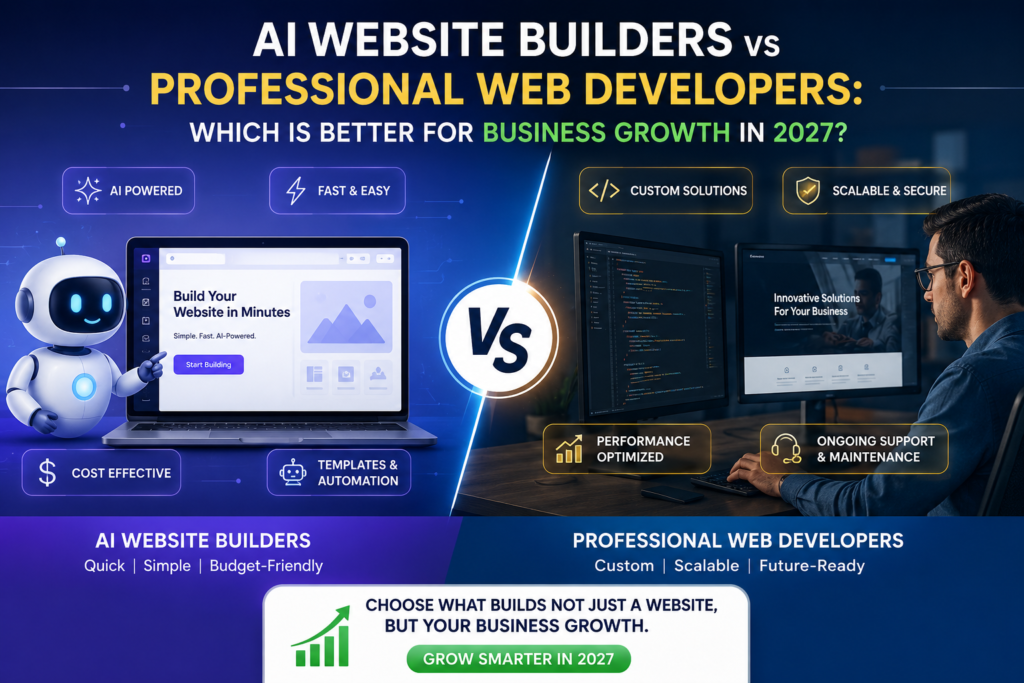
AI Website Builders vs Professional Web Developers is not a simple contest between new and old technology. AI website builders are often better for a quick prototype, temporary campaign, personal portfolio or very small business with standard requirements and a limited budget. Professional web developers are usually better when the website is expected to generate leads, process sales, integrate with business systems, rank competitively, express a distinctive brand or scale without an early rebuild.
For many growth-focused businesses in 2027, the strongest choice is a hybrid model. Skilled developers can use AI to accelerate research, drafts, testing and routine code while retaining human responsibility for strategy, user experience, architecture, security, accessibility, performance and conversion. The business receives the speed benefits of AI without handing critical decisions to an automated template.
What Is an AI Website Builder?
An AI website builder is a platform that uses prompts, generated layouts, template selection and automated content tools to create a website with limited manual design or coding. The category is broad. Some products are conventional drag-and-drop builders with AI-assisted setup. Others generate layouts, copy, images or code from a written brief. The quality and flexibility therefore vary considerably from one platform to another.
- Prompt-led setup: The user describes the business, audience, style and required pages.
- Automated layout: The platform selects sections, typography, colours and navigation from a design system.
- Generated content: AI may draft headlines, service descriptions, FAQs and calls to action.
- Hosted platform: Hosting, updates and core platform security are usually bundled into a subscription.
- Visual editing: The owner adjusts content and layout without directly editing code.
- Built-in features: Forms, blogs, bookings, stores or analytics may be available through native features or paid apps.
What Does a Professional Web Developer Provide?
A professional web developer or web development company converts business goals into a technical and customer-facing solution. The work normally includes discovery, information architecture, user experience, interface design, front-end development, back-end development, content management, integrations, testing, launch and ongoing maintenance. A professional team can still use AI tools, but a qualified person reviews the work and remains accountable for the delivered system.
The Web Development Company Australia website describes custom websites, web applications, WordPress, WooCommerce, Shopify, performance, mobile experience, conversion flow, SEO readiness and ongoing support as core service areas. That breadth matters because a business website rarely succeeds through appearance alone. The website must connect marketing, content, technology and operations.
Related services: View web design and development services | Explore all website development services
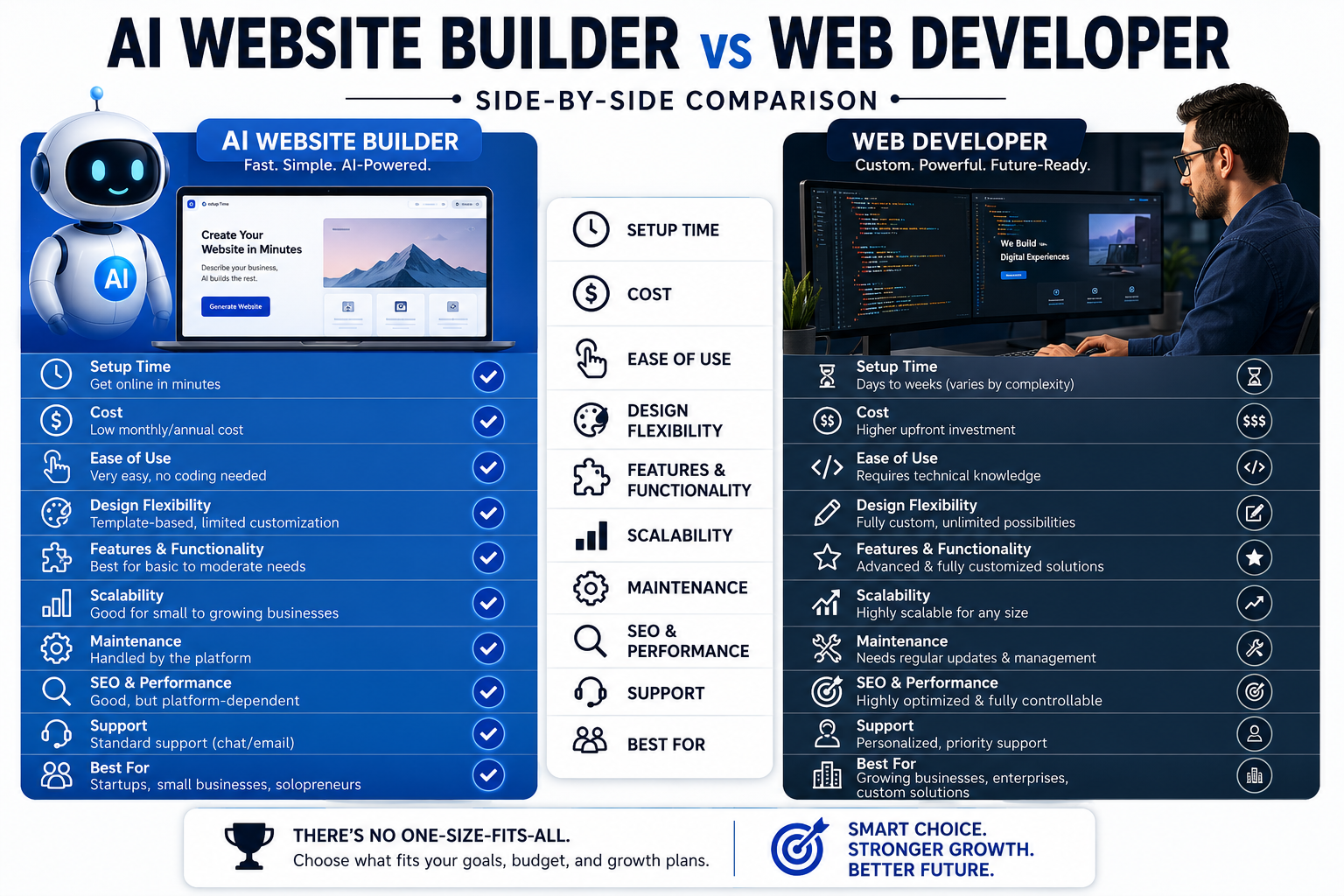
AI Website Builder vs Web Developer: Side-by-Side Comparison
| Decision factor | AI website builder | Professional web developer | Growth implication |
| Launch speed | Hours or days for a simple site. | Weeks or longer, depending on discovery, design and complexity. | AI is strong for urgent validation; professional work reduces expensive rework for strategic sites. |
| Initial cost | Usually lower subscription and setup cost. | Higher professional investment. | Low upfront cost can be useful, but total cost includes apps, limitations, migration and lost conversion. |
| Customisation | Constrained by themes, components and platform rules. | Can be designed around customers, workflows and brand. | Custom journeys can support differentiation and higher-value actions. |
| SEO control | Basic tools may cover metadata, sitemaps and simple editing. | Can address architecture, rendering, schema, internal linking, redirects and technical performance. | Competitive organic growth often needs deeper control. |
| Performance | Can be acceptable, but platform scripts and generic components may limit optimisation. | Can be engineered and tested for target devices, content and traffic. | Faster, stable pages can reduce friction and support conversion. |
| Security | Core platform protection is managed, but app quality, configuration and account security still matter. | Can implement tailored controls, testing, access and secure integrations, with maintenance obligations. | Neither option is automatically secure. Risk depends on design, configuration and operations. |
| Scalability | Works well while needs remain inside the platform. | Can be architected for complex data, integrations and growth. | A builder may create lock-in or migration costs when requirements change. |
| Ownership | Content may be exportable, while layouts, features or code can remain platform-dependent. | Contracts can define ownership of code, design, data and accounts. | Clear ownership improves portability and bargaining power. |
| Support | Standard support and documentation. | Direct advice, troubleshooting, maintenance and roadmap support. | Human support is valuable when downtime or revenue is at risk. |
| Conversion strategy | Generated best-practice patterns with limited business context. | Research-led journeys, testing and tailored calls to action. | Conversion quality, not page count, drives business value. |
Where AI Website Builders Perform Well
Rapid proof of concept
A founder can test an idea, message or landing page before funding a larger build.
Basic brochure websites
A small operation with a few services, no integrations and modest traffic may get an acceptable starting site.
Temporary campaigns
A short event, survey or internal initiative may not justify custom engineering.
Personal portfolios
Individuals can publish work quickly without ongoing development support.
Drafting and inspiration
AI can help generate layout directions, initial copy and component ideas even when a professional build follows.
Simple owner-managed updates
Visual editing may suit teams that need to change ordinary content without technical help.
Recent industry comparisons generally agree that AI builders are strongest on speed, low initial cost and ease of use for standardised requirements. They also warn that the label “AI website builder” covers products with very different levels of code quality, exportability, control and support. A business should test the exact platform rather than buying the category promise.
Where AI Website Builders Can Limit Growth
Generic positioning
Generated copy and layouts can sound similar to competitors. Without customer insight, the site may describe services without proving why the business is the better choice.
Template boundaries
A builder may handle a standard contact path but struggle with complex quoting, member areas, multilingual workflows, product configurators or unusual data relationships.
Hidden app dependency
A low monthly price can grow as the business adds forms, bookings, memberships, ecommerce, automations, analytics and premium support.
Technical SEO constraints
The platform may limit routing, rendering, structured data, log access, advanced redirects, international SEO or precise performance work.
Performance overhead
Generic scripts, third-party apps and visual effects may create slow pages or layout instability that the owner cannot fully optimise.
Vendor lock-in
A website may not transfer cleanly. Moving can involve rebuilding layouts, features, forms, integrations and content relationships.
Inconsistent accessibility
Generated colour, headings, forms, keyboard behaviour and alternative text still require human accessibility review.
Security assumptions
Hosted does not mean risk-free. Account compromise, unsafe plugins, weak consent flows, exposed data and incorrect permissions remain possible.
Weak measurement
A builder can publish a site without a tracking plan, conversion definitions, consent design or data-quality controls.
No strategic challenge
Automation follows inputs. It may not question an unclear offer, unrealistic customer journey or the wrong business objective.
Where Professional Web Developers Create Business Value
Discovery and strategy
A developer or agency can clarify goals, customer segments, search demand, buying journeys, content gaps and operational constraints before selecting technology.
Custom user experience
Navigation, page structure and interactions can be designed around the actions that matter: enquiries, bookings, purchases, applications or account use.
SEO-ready architecture
Professional development can combine crawlable structure, clean redirects, structured data, internal links, performance and editable content with an ongoing SEO plan.
Conversion engineering
Forms, trust signals, proof, calls to action and checkout flows can be adapted to real objections and measured outcomes.
Business integrations
CRM, ERP, payment, inventory, booking, learning, identity, analytics and marketing systems can exchange data through governed integrations.
Performance optimisation
Developers can profile loading, reduce scripts, optimise images, improve caching and test across devices and network conditions.
Security and maintenance
A professional team can manage updates, backups, monitoring, access, vulnerability response and recovery planning.
Scalability and roadmap
Architecture can anticipate multiple products, locations, languages, roles, content volumes and future services.
Accountability
A defined scope, quality process, test plan, handover and support agreement provide clearer responsibility when problems occur.
Hybrid AI productivity
Professional developers can use AI for repetitive work while reviewing architecture, code, content and security with expert judgement.
Cost Comparison for Australian Businesses in 2027
Pricing varies too widely for one number to be reliable. An AI builder may begin with a low monthly subscription, while a professional site may involve discovery, design, development, testing, content and maintenance. The correct comparison is total cost of ownership over the period the site must support the business.
| Cost area | Questions for an AI builder | Questions for a professional build |
| Setup | Is the generated site usable without premium templates, copy editing or specialist setup? | What discovery, design, content, development and testing are included? |
| Subscription | Which features require paid tiers, apps, storage or transaction fees? | What hosting, licences and service subscriptions continue after launch? |
| Internal time | How much time will the owner spend writing, configuring, fixing and learning the platform? | Who supplies content and approvals, and how much stakeholder time is required? |
| Growth | What does adding products, locations, languages, automation or custom workflows cost? | Which future capabilities are already anticipated in the architecture? |
| Risk | What happens if the platform changes pricing, terms, features or export rules? | What are the backup, warranty, support, security and ownership arrangements? |
| Opportunity cost | Could limited SEO, conversion or functionality reduce leads or sales? | What outcomes and measurement plan justify the higher investment? |
SEO: Can AI-Built Websites Rank on Google?
Yes, an AI-built website can rank. Google does not award rankings based on whether a page was created by an AI builder or a human developer. Search performance depends on useful content, crawlability, relevance, authority, page experience and competition. The real issue is whether the chosen platform gives the business enough control to execute a serious SEO strategy.
- Crawl and indexing: Can search engines access important content without unnecessary scripts, blocked resources or duplicate routes?
- Information architecture: Can the business create clear service, product, location, category and resource structures?
- Metadata and canonicals: Can titles, descriptions, canonical URLs and social previews be managed properly?
- Structured data: Can appropriate schema be implemented and maintained without unreliable plugins?
- Redirects: Can redesigns or deleted pages use controlled permanent redirects?
- Performance: Can the team improve Core Web Vitals, images, fonts, scripts and caching?
- Content workflow: Can subject-matter experts publish and update useful content efficiently?
- Measurement: Are analytics, search performance, conversions and consent implemented correctly?
AI can accelerate outlines and drafts, but publishing large volumes of generic content is not an SEO strategy. Human research, first-hand expertise, accurate claims, useful examples and editorial review are required if the website is intended to build trust and organic visibility.
Security, Privacy and Compliance
Both approaches introduce risk. An AI builder may reduce the owner’s responsibility for server maintenance, yet the business still controls accounts, passwords, content, forms, data collection, third-party apps and staff access. A custom site provides deeper control, but that control creates maintenance and governance obligations. The safer option is the one that has clear ownership, secure configuration, regular updates, tested backups and a proportionate response plan.
- Data location and processing: Understand where form, customer, analytics and AI prompt data are stored and processed.
- Access control: Use multifactor authentication, least privilege and prompt removal of former users.
- Third-party apps: Review permissions, data access, reputation, support and update history.
- Payments: Use established payment providers and avoid handling card data unnecessarily.
- Backups and recovery: Confirm frequency, retention, restoration testing and responsibility.
- Privacy and consent: Use appropriate notices, cookie controls and lawful data practices for the business context.
- Updates: Know who patches the platform, themes, plugins, integrations and custom code.
- Incident response: Document who will act if the site is compromised or unavailable.
Which Option Is Better for Different Businesses?
Solo professional or early side business
An AI builder may be enough for a simple offer, contact form and small content library. Choose a platform that allows export or affordable migration.
Local service business
A hybrid or professional build is often better when local SEO, calls, quote requests, reviews and multiple service areas drive revenue.
Ecommerce store
Professional support is valuable for product architecture, checkout, payments, shipping, analytics, integrations, security and conversion. Shopify or WooCommerce can still provide the platform while developers customise it.
Growing business-to-business company
A professional site is usually justified when lead quality, CRM integration, account-based journeys, case studies and authority content matter.
Startup testing demand
Use AI for a landing page or prototype, then move to professional development after validating the proposition and customer journey.
Regulated or sensitive organisation
Prioritise professional architecture, privacy, accessibility, security, auditability and formal governance.
Marketplace, portal or software product
Custom development is normally required because identity, roles, data, transactions and integrations exceed template boundaries.
Established brand redesign
Use professionals to protect SEO equity, redirects, analytics, content migration, accessibility and brand consistency.
The Hybrid Model: Often the Best Choice for 2027
The most practical 2027 model is not AI alone or humans without AI. It is AI-assisted professional development. Developers can use AI for repetitive code, draft content structures, test generation, documentation and rapid prototypes. Designers and strategists can explore alternatives faster. Human specialists then validate the work against business goals, customer research, accessibility, security, maintainability and measurement.
- Use AI to accelerate discovery summaries, not replace customer interviews.
- Use AI to suggest page structures, then validate the journey with real user needs.
- Use AI to draft code, then review, test and secure it professionally.
- Use AI to draft content, then add expertise, evidence, brand voice and legal review.
- Use AI to generate test cases, then perform device, browser, accessibility and integration testing.
- Keep final architecture, launch and risk decisions with accountable people.
Website Growth Needs Across Australian Cities
- Sydney: Competitive finance, technology, professional services and ecommerce markets often justify strong conversion strategy, SEO and integrations.
- Melbourne: Retail, health, education, property, professional services and startups need flexible sites that support content and campaign growth.
- Brisbane: Growing service, construction, health, technology and government-adjacent businesses can benefit from fast mobile journeys and local search visibility.
- Perth: Resources, trades, professional services and distributed operations may require lead generation, recruitment, portals and reliable support.
- Adelaide: Defence, manufacturing, education, health and emerging technology businesses may need security, accessibility and clear stakeholder journeys.
- Canberra: Government suppliers and professional services should consider accessibility, security, records, credibility and procurement requirements.
- Gold Coast: Tourism, property, health, education and local services need mobile-first bookings, enquiries and location-focused content.
- Hobart and Darwin: Smaller markets can reward clear local relevance, fast sites and professional credibility, while online services can extend reach nationally.
View professional web development for Melbourne businesses
Decision Checklist Before You Choose
- Is the website a test, brochure, lead-generation channel, ecommerce store or operational system?
- What revenue or customer-service result must the website support?
- Which integrations, roles, data and workflows are required now and in two years?
- How competitive is organic search in the market?
- What accessibility, privacy, security or regulatory obligations apply?
- Who owns the domain, hosting, analytics, accounts, design, code and content?
- Can the site move to another provider or platform?
- What happens when an update breaks a form, checkout or integration?
- How will conversions, speed, search visibility and lead quality be measured?
- What is the three-year total cost, including staff time and migration risk?
- Does the supplier provide a documented scope, test process, handover and support model?
- Would a hybrid AI-assisted professional build provide both speed and control?
Questions to Ask an AI Website Builder Vendor
- Can every page, image, product and data record be exported in a usable format?
- Can the domain, analytics and advertising accounts remain in the business name?
- What are the limits for products, traffic, storage, languages, forms and integrations?
- Which features require paid apps or higher plans?
- How are AI prompts and generated content handled?
- Can advanced redirects, schema, consent and technical SEO be implemented?
- What accessibility testing is included?
- What support is available during an outage or compromised account?
- What happens to the site if the subscription ends?
Questions to Ask a Professional Web Developer
- How will discovery connect website decisions to business goals and customers?
- What is included in design, content, development, SEO, testing and launch?
- Who owns the domain, accounts, code, design files, content and data?
- How will performance, accessibility, security and browser testing be handled?
- Which platform and integrations are recommended, and why?
- What assumptions, exclusions and client responsibilities are in the scope?
- How are changes controlled and priced?
- What training, documentation, warranty and maintenance are provided?
- How will success be measured after launch?
Frequently Asked Questions
Are AI website builders better than web developers?
AI builders are better for speed, low initial cost and simple requirements. Professional developers are better for customisation, integrations, competitive SEO, conversion strategy, security governance and long-term scale.
Can AI replace professional web developers?
AI can automate parts of design and coding, but it does not replace business discovery, architecture, trade-off decisions, testing, accountability and ongoing support. Professional developers are increasingly using AI as a productivity tool.
Are AI websites good for SEO?
They can rank when the platform is crawlable and the content is useful. Competitive SEO may require more control over architecture, performance, structured data, redirects, content workflows and measurement than some builders provide.
How much does an AI website builder cost?
Pricing ranges from free or low-cost plans to higher subscriptions with ecommerce, apps, storage and support. Compare the full three-year cost and migration risk, not only the advertised monthly price.
How much does professional web development cost in Australia?
The cost depends on strategy, design, page types, content, ecommerce, integrations, custom functionality, testing and support. A written discovery and scope are more reliable than a generic price range.
What is best for a small Australian business?
An AI builder may suit a basic early-stage site. A professional or hybrid build is stronger when calls, enquiries, bookings, local SEO or sales materially affect growth.
What is best for ecommerce?
Established ecommerce platforms such as Shopify or WooCommerce can work well, but professional development is valuable for product structure, checkout, integrations, performance, analytics and conversion.
Can I start with AI and hire a developer later?
Yes. Confirm domain ownership, data export, redirects and migration options before launch so the first platform does not become an expensive barrier.
What is the best option for business growth in 2027?
For most businesses that rely on their website for revenue or operations, AI-assisted professional development offers the strongest balance of speed, quality, control and scalability.
Final Verdict
AI Website Builders vs Professional Web Developers should be decided by business risk and growth ambition. Choose an AI builder when speed, simplicity and a small experiment matter most. Choose professional web development when the site must generate revenue, rank competitively, integrate with operations, protect sensitive data or scale. When possible, use a hybrid approach in which professionals use AI to move faster while remaining accountable for strategy, quality and results.
Ready to plan a growth-focused website? Request a free website development quote