
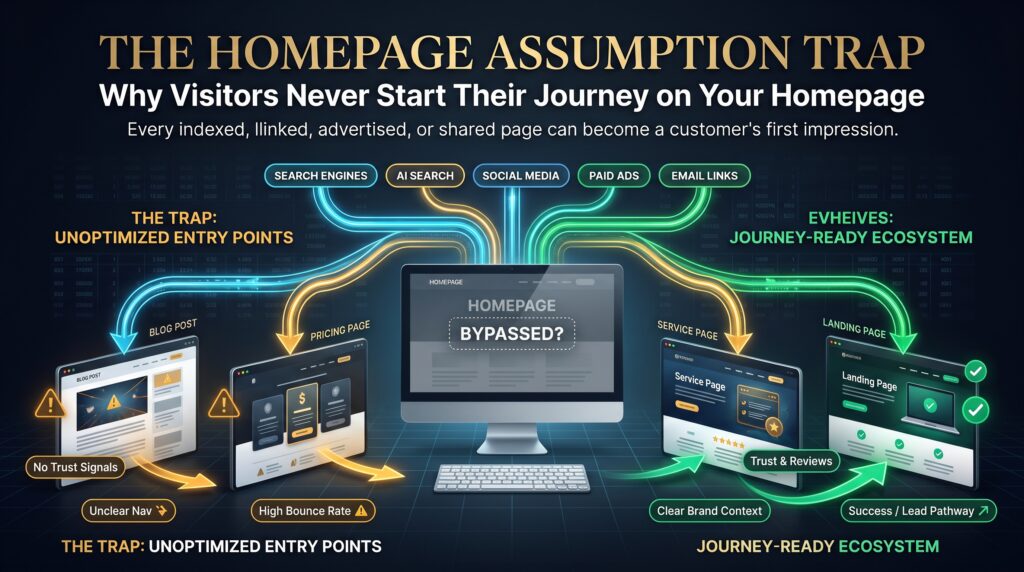


Website landing pages are where most visitor journeys really begin, yet many businesses still design as if everyone walks in through the front door. They polish the homepage, debate the hero banner for weeks, and leave every other page to fend for itself. That is the homepage assumption trap, and it quietly costs enquiries and sales.
In this guide we explain why visitors rarely start on your homepage, how to find the pages they actually enter on, and how to turn every page into a front door that guides people to act. If you run a business in Sydney, Melbourne, Brisbane, Adelaide, Canberra or Perth, the steps below apply to you.
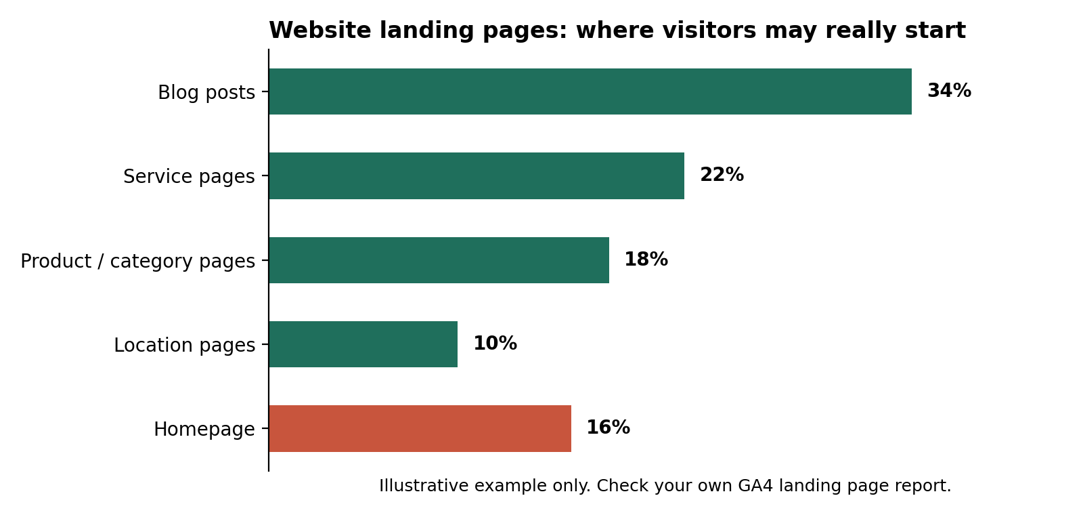
Illustrative example only. Check your own analytics for the real split.
What Is the Homepage Assumption Trap?
The homepage assumption trap is the belief that a typical visitor lands on your homepage, reads your story, explores the menu and then chooses a service. It is a tidy picture. It is also rarely how people behave.
Real visitors arrive from a search result, a shared link, an email, an ad or a recommendation. They land on a specific page that matches the question in their head. If that page does not explain who you are and what to do next, they leave. Your homepage never gets the chance.
Why Visitors Land Everywhere Except Your Homepage
Search engines rank individual pages, not whole websites. When someone searches for a specific problem, Google sends them to the page that answers it. Several other routes also bypass the front door.
- Search results: a blog post, service page or product page ranks for a specific query, so the click goes straight there.
- Social and messaging links: people share the page that helped them, not your homepage address.
- Email and ad campaigns: each campaign points to a chosen destination, and good campaigns never point to the homepage.
- Referrals and directories: other sites link to the page they find most useful or relevant.
- Returning visitors: bookmarks and saved tabs send people deep into your site.
Add these up and a large share of sessions on most sites begin on website landing pages other than the homepage. Your own analytics will show the exact split, and it is worth checking before you plan another redesign.
How Website Landing Pages Really Work
A landing page is simply the first page someone sees in a session. By that definition, every page on your site is a landing page. A forgotten blog post from two years ago can be your busiest entry point, and your most expensive service page might be one that nobody reaches first.
This changes how you should think about design. Instead of one hero page and a pile of supporting pages, you have dozens of website landing pages, each meeting a stranger with a different goal. Each one needs to answer three questions within seconds: Am I in the right place? Can I trust this business? What should I do next?
The Cost of Ignoring Website Landing Pages
When inner pages are built as afterthoughts, the damage is easy to miss because the homepage looks great in every design review. Here is what usually goes wrong.
- No context: the page assumes the reader already knows who you are, so first-time visitors feel lost.
- No next step: the content ends without a call to action, so interested visitors have nowhere to go.
- Weak navigation cues: visitors cannot tell where they are or how to reach your services, pricing or contact details.
- Slow mobile loading: heavy images and scripts push people away before they read a word.
- Inconsistent trust signals: reviews, guarantees and contact details appear on the homepage only.
Ignoring website landing pages also wastes marketing spend. If you pay for clicks or invest in content, you are paying to send people to pages that were never designed to convert.
How to Find Your Real Entry Points
You do not need to guess. Two free tools show where journeys begin.
- Check the landing page report in Google Analytics. Look at which pages start the most sessions, then compare their engagement and conversion rates with your homepage.
- Review the Pages report in Google Search Console. It shows which pages earn impressions and clicks from search, which points to your future top entry pages. Google’s own SEO starter guide explains how search engines treat individual pages.
- Segment by source. Organic search, paid ads, email and social often land on completely different pages, so review each one separately.
- List your top ten entry pages. These are your real front doors. Start improving those website landing pages first.
7 Fixes: Design Every Page as a Front Door
Once you know where visitors arrive, apply these seven fixes to your most important website landing pages first.
- Lead with a clear promise. The headline and first paragraph should confirm the visitor is in the right place and say what the page offers.
- Add context quickly. A short line about who you are, who you help and where you operate stops first-time visitors from bouncing.
- Put one primary call to action on every page. It might be “Get a free quote”, “Call now” or “Add to cart”, but each page should point somewhere.
- Make navigation orient the visitor. Breadcrumbs, a visible menu and a search box help people move from the page they landed on to the page they need.
- Prioritise mobile speed. Most visitors arrive on phones. Follow Google’s Core Web Vitals guidance to keep loading, interaction and layout stability healthy.
- Repeat trust signals everywhere. Reviews, certifications, case studies and contact details belong on every entry page, not only the homepage.
- Review the top ten pages monthly. Entry pages change as rankings and campaigns change, so keep checking.
A Landing Page Checklist by Page Type
Different pages meet different intent. Use this table as a quick brief when you review or build website landing pages.
| Page type | Visitor intent | What it must do | Primary CTA |
| Blog post | Learning or researching | Answer the question, then guide to a related service | Related service or newsletter |
| Service page | Comparing providers | Show proof, process and pricing cues | Get a free quote |
| Product or category page | Ready to buy | Fast filters, clear photos, reviews | Add to cart |
| Location page | Local intent | Local proof, phone number, map or area | Call now |
| Homepage | Brand search or return visit | Route people to the right path quickly | Choose a service |
For ecommerce stores, research from the Baymard Institute on product and checkout usability is a helpful companion when you refine product and category pages.
Website Landing Pages Across Australian Cities
Local intent makes the homepage assumption trap even more costly. Someone searching for a developer in their own city usually lands on a location or service page, not your homepage. These pages need local proof, a clear phone number and a simple way to request a quote.
- Sydney: competitive searches reward pages with strong proof and clear service detail. See our Sydney web development
- Melbourne: businesses often compare several providers, so pricing cues and case studies help. Visit our Melbourne
- Brisbane: local service businesses benefit from pages that load fast on mobile. Explore Brisbane.
- Adelaide: smaller markets reward clear, trustworthy local pages. Check Adelaide.
- Canberra: government and professional services buyers value clarity and credibility. Read about Canberra.
- Perth: resources and trades businesses need quick, mobile-friendly enquiry paths. See Perth.
You can browse every service area on our locations page.
Build Website Landing Pages That Convert
Fixing the homepage assumption trap is part strategy and part build quality. The right structure, fast code and a platform your team can edit make it easy to keep every page effective.
Our team builds conversion-focused sites on WordPress, WooCommerce, Shopify and Webflow. If your current site looks fine but underperforms, an ecommerce website redesign or a fresh round of web design and development can turn weak entry pages into real lead generators. Small businesses can start with our small business website development service, and online stores can add ecommerce SEO to bring the right visitors to the right pages.
See all of our web development services, learn more about us, read the blog, check the FAQs or get a free quote. You can also call 1300 649 299.
Website Landing Pages: Frequently Asked Questions
What are website landing pages?
A landing page is the first page a visitor sees in a session. Any page on your site can be a landing page, whether it is a blog post, service page, product page or your homepage.
Is the homepage still important?
Yes. The homepage still matters for brand searches, returning visitors and credibility. It just should not be the only page you design carefully.
How do I find which pages visitors land on?
Open the landing page report in Google Analytics and the Pages report in Google Search Console. Together they show where sessions start and which pages earn search traffic.
How do I improve website landing pages quickly?
Start with your top ten entry pages. Add a clear headline, a short line of context, trust signals and one call to action, then check mobile speed.
Final Thoughts
The homepage is one door among many. Visitors arrive through search results, shared links and campaigns, and they judge your business on whichever page they meet first. Design your website landing pages with that reality in mind and more visitors will find what they need, trust what they see and take the next step. Ready to start? Talk to our team for a free quote.